Author: kiyanshahbazi2009@gmail.com

  • **M&T Bank Expands Enterprise AI Following Years-Long Technology Overhaul**

    **M&T Bank Expands Enterprise AI Following Years-Long Technology Overhaul**

    # M&T Bank Expands Enterprise AI Rollout to More Than 15,000 Employees

    M&T Bank is accelerating its artificial intelligence strategy, rolling out AI copilots to more than 15,000 employees as part of a broader effort to modernize internal operations, improve customer service, and strengthen risk management.

    According to reporting cited by *Fast Company*, the US regional bank is using AI across several key business areas, including call-centre analytics, report drafting, software development, customer insight generation, and portfolio risk monitoring. The move reflects a growing trend among financial institutions: using enterprise AI not only for customer-facing tools, but also to improve productivity and decision-making behind the scenes.

    ## AI Becomes Part of Daily Banking Operations

    M&T Bank’s deployment of AI copilots gives employees access to tools that can help automate routine tasks, summarize information, and support more efficient workflows. In banking, where staff often handle large volumes of customer data, compliance documentation, and operational reports, AI can help reduce repetitive work and allow employees to focus on higher-value activities.

    One major use case is call-centre analysis. AI can review customer conversations to identify common issues, detect customer needs, and provide insights that help the bank improve service quality. This can be especially valuable for regional banks that compete on customer relationships and personalized support.

    ## Supporting Software Development and Internal Productivity

    M&T is also applying AI to software development by using generative AI tools to help produce code. AI coding assistants can support developers by suggesting code, identifying errors, and speeding up development cycles. For banks undergoing digital transformation, this can help modernize legacy systems and deliver new digital services faster.

    The bank’s use of AI for drafting reports is another example of how generative AI is moving into everyday office work. Employees can use AI to create first drafts, summarize complex information, and prepare internal documents more quickly, while human staff remain responsible for reviewing and validating the output.

    ## AI in Risk Management

    Risk management is a critical area for any financial institution, and M&T is using AI to flag potential portfolio risks. By analyzing large datasets, AI systems can help identify patterns that may indicate financial exposure, emerging credit concerns, or changes in customer behavior.

    While AI does not replace traditional risk teams, it can provide earlier signals and support more informed decision-making. In a highly regulated sector like banking, these tools must be carefully governed to ensure accuracy, fairness, and compliance.

    ## A Sign of Broader AI Adoption in Banking

    M&T Bank’s AI expansion follows years of technology modernization and reflects the wider shift taking place across the financial services industry. Banks are increasingly exploring enterprise AI to boost efficiency, enhance customer experiences, and remain competitive in a fast-changing digital market.

    However, the adoption of AI in banking also brings important challenges. Financial institutions must manage data privacy, cybersecurity, model accuracy, regulatory compliance, and employee training. Successful AI implementation depends not only on deploying tools, but also on building strong governance frameworks and ensuring employees understand how to use AI responsibly.

    ## What This Means for the Future

    M&T Bank’s rollout shows how AI is becoming embedded in the core operations of financial institutions. Rather than being limited to experimental projects, AI is now being used at scale to support thousands of employees across multiple departments.

    If implemented effectively, the technology could help M&T improve productivity, deliver better customer service, speed up software development, and identify risks more quickly. The bank’s approach also highlights a broader reality for the industry: AI is no longer just an innovation project — it is becoming a central part of modern banking strategy.

  • **M&T Bank Expands Enterprise AI Following Years-Long Technology Overhaul**

    **M&T Bank Expands Enterprise AI Following Years-Long Technology Overhaul**

    # M&T Bank Expands Enterprise AI to 15,000 Employees After Major Technology Overhaul

    M&T Bank is accelerating its use of artificial intelligence across the organisation, deploying AI copilots to more than 15,000 employees as part of a broader effort to modernise internal operations, improve customer service, and strengthen risk management.

    According to Fast Company, the US regional bank is applying AI in several areas of its business, including call-centre analysis, report drafting, software development, customer support, and portfolio monitoring. The move reflects a growing trend in the financial sector, where banks are increasingly adopting AI tools not only for customer-facing services but also for everyday employee productivity.

    ## AI Copilots for Everyday Banking Work

    The deployment of AI copilots gives M&T employees access to tools that can assist with routine tasks, speed up workflows, and help staff focus on higher-value work. These AI systems can support employees by summarising information, drafting documents, generating insights, and helping teams make faster decisions.

    For a large financial institution, this type of technology can be especially valuable. Banking employees often work with large amounts of data, customer records, compliance requirements, and internal documentation. AI copilots can help reduce manual effort and make information easier to access and use.

    ## Improving Customer Service with AI

    One of the key areas where M&T Bank is using AI is in customer service. The bank is analysing call-centre conversations to better understand customer needs, identify common issues, and improve service quality.

    By reviewing customer interactions at scale, AI can help the bank detect patterns that may not be obvious through manual review. For example, it can highlight recurring customer concerns, identify opportunities to improve products, or help service teams respond more effectively.

    This does not necessarily replace human customer support. Instead, AI can act as a support layer, giving employees better information and helping them serve customers more efficiently.

    ## Supporting Software Development

    M&T Bank is also using AI to generate code and support software development. This is becoming one of the most common enterprise AI use cases, as developers use AI tools to write code, review existing systems, create documentation, and speed up testing.

    For banks, faster software development can be important as they modernise legacy systems and build more digital services. However, financial institutions must also ensure that AI-generated code is carefully reviewed for security, compliance, and reliability.

    ## AI in Risk Management

    Another important use case is risk management. M&T Bank is using AI to help flag portfolio risks, giving teams better tools to identify potential problems early.

    Risk management is a critical function in banking, and AI can help by analysing large datasets, detecting unusual trends, and surfacing warning signs. This can support human analysts and decision-makers by providing faster insights and improving visibility across portfolios.

    ## A Sign of AI’s Growing Role in Banking

    M&T Bank’s AI expansion shows how quickly artificial intelligence is becoming part of mainstream banking operations. While many early AI discussions focused on chatbots or customer-facing tools, banks are now using AI across internal departments, from operations and technology to compliance and risk.

    The deployment also highlights the importance of long-term technology investment. AI adoption at this scale usually requires strong data systems, cloud infrastructure, cybersecurity controls, employee training, and governance frameworks.

    ## Balancing Innovation with Responsibility

    As with any AI deployment in financial services, responsible use will be essential. Banks must ensure that AI tools are accurate, secure, explainable, and compliant with regulations. They also need to protect customer data and make sure employees understand how to use AI appropriately.

    For M&T Bank, the challenge will be to capture the benefits of AI while maintaining trust, security, and regulatory discipline.

    ## Conclusion

    M&T Bank’s rollout of AI copilots to more than 15,000 employees marks a significant step in the bank’s digital transformation. By using AI to support customer service, internal reporting, software development, and risk management, the bank is positioning itself to operate more efficiently and respond more quickly to customer and business needs.

    The move is another example of how AI is shifting from experimental projects to everyday enterprise tools, especially in highly regulated industries like banking.

  • **Nvidia’s Lab-Funded Growth: A Quarter of Next Year’s Business Tied to Labs It Finances**

    **Nvidia’s Lab-Funded Growth: A Quarter of Next Year’s Business Tied to Labs It Finances**

    ## Nvidia’s AI Boom Raises Questions Over “Circular Financing” as Backed Labs Drive Demand

    Nvidia’s rise has become one of the defining stories of the artificial intelligence boom. As demand for high-performance chips continues to surge, the company is not only selling the hardware that powers many of today’s leading AI models — it is also helping finance some of the companies buying those chips.

    According to recent reports, Nvidia has invested nearly **US$50 billion** into AI labs and related companies that purchase its processors. The company has also reportedly lined up commitments worth more than **US$500 billion**, highlighting just how deeply connected Nvidia has become to the fast-growing AI infrastructure ecosystem.

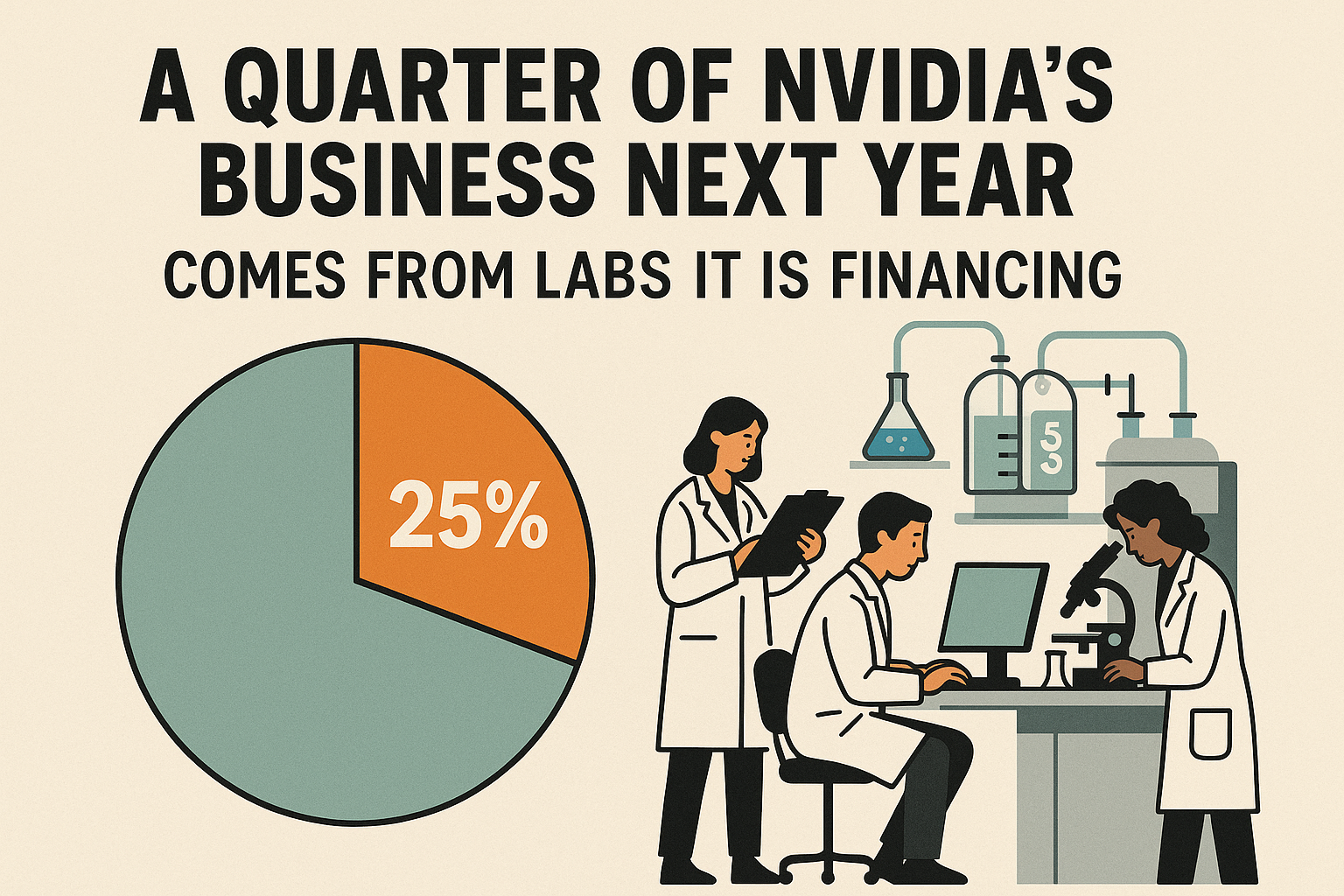
    During an analyst briefing on August 26, Nvidia chief financial officer **Colette Kress** said that demand from AI labs backed by Nvidia’s own balance sheet is expected to account for roughly **a quarter of the company’s business next year**. That figure has attracted attention because it suggests a significant portion of Nvidia’s future revenue may come from companies it is also financially supporting.

    ### Why Nvidia Is Investing in Its Customers

    Nvidia’s strategy reflects the intense race to build AI infrastructure. Training and running advanced AI models requires massive computing power, and Nvidia’s GPUs remain the dominant choice for many AI developers. By investing in AI labs and infrastructure companies, Nvidia can help ensure that these firms have the capital needed to buy chips, build data centres, and scale their operations.

    From Nvidia’s perspective, this can be seen as a way to accelerate the overall AI market. If promising AI companies lack funding to purchase compute capacity, Nvidia’s investments can help unlock that demand. In return, Nvidia benefits from stronger chip sales, deeper customer relationships, and a larger role in shaping the future AI ecosystem.

    ### The Concern: Circular Demand

    However, the arrangement also raises concerns about what some analysts describe as **circular financing**. This occurs when a company invests in customers that then use the capital, directly or indirectly, to buy that same company’s products.

    In Nvidia’s case, critics may question whether some of the demand for its chips is being artificially boosted by its own investments. If a major share of future sales comes from companies Nvidia has financed, investors may want to understand how much of that demand is sustainable without Nvidia’s support.

    This does not necessarily mean the demand is weak or illegitimate. AI companies genuinely need huge amounts of computing power, and Nvidia’s chips are widely viewed as essential to the sector. But the financial relationship between supplier and customer adds complexity to how Nvidia’s growth should be evaluated.

    ### A Sign of Nvidia’s Power in the AI Economy

    The situation also demonstrates Nvidia’s extraordinary position in the AI market. The company is no longer simply a chipmaker. It has become a key financier, infrastructure partner, and strategic force behind much of the AI industry’s expansion.

    AI labs, cloud providers, data centre operators, and enterprise technology companies are all competing for access to advanced GPUs. Nvidia’s ability to influence where capital flows gives it an even stronger role in determining which companies can scale quickly.

    ### What Investors Will Be Watching

    Going forward, investors and analysts are likely to focus on several key questions:

    – How much of Nvidia’s revenue is coming from companies it has invested in?
    – Are those customers generating enough independent revenue to sustain future chip purchases?
    – Could Nvidia face increased financial risk if some AI labs fail to become profitable?
    – Will regulators or market observers scrutinise these relationships more closely?
    – Is the current AI infrastructure buildout based on long-term demand or short-term hype?

    The answers will matter not only for Nvidia, but for the broader AI market. If AI adoption continues to expand rapidly, Nvidia’s investment strategy may prove highly effective. But if the market slows, the company could face criticism for creating a feedback loop between financing and sales.

    ### Conclusion

    Nvidia’s financial backing of AI labs shows how central the company has become to the artificial intelligence boom. Its chips power the industry, its investments help fund the companies building AI models, and its business is increasingly tied to the success of those same customers.

    The fact that roughly a quarter of Nvidia’s business next year may come from labs it supports financially is both a sign of strength and a source of concern. It highlights massive demand for AI infrastructure, but also raises important questions about the sustainability and independence of that demand.

    As the AI race continues, Nvidia’s role will remain critical — not just as a supplier of chips, but as one of the most influential financial players in the future of artificial intelligence.

  • **Nvidia-Funded Labs Set to Account for a Quarter of Its Business Next Year**

    **Nvidia-Funded Labs Set to Account for a Quarter of Its Business Next Year**

    ## Nvidia’s AI Boom Raises Questions Over “Circular Financing” as Backed Labs Drive Future Sales

    Nvidia’s dominance in the artificial intelligence market is becoming even more closely tied to the companies building the next generation of AI systems. According to recent reports, the chipmaker has invested nearly **US$50 billion** into AI labs and related companies that are also major buyers of its high-performance GPUs. In addition, Nvidia has reportedly lined up commitments worth more than **US$500 billion**, highlighting the enormous scale of demand for AI infrastructure.

    Speaking to analysts on August 26, Nvidia Chief Financial Officer **Colette Kress** said that demand from AI labs supported by Nvidia’s own balance sheet is expected to contribute to roughly **a quarter of the company’s business next year**. That figure underlines just how important these partnerships have become to Nvidia’s growth strategy.

    ### Nvidia’s role at the centre of the AI economy

    Nvidia has become the key hardware supplier for the global AI boom. Its GPUs are widely used to train and run advanced AI models, making them essential for companies developing large language models, generative AI tools, and enterprise AI platforms.

    As AI labs race to build larger models and expand computing capacity, demand for Nvidia chips has surged. This has helped push the company’s revenue and market value to record levels. However, the latest details about Nvidia financing some of the same companies that buy its chips have raised questions about how sustainable parts of that demand may be.

    ### What is “circular financing”?

    The situation is being described by some analysts as a form of **circular financing**. In simple terms, this happens when a company invests money into customers or partners, who then use part of that money to buy products or services from the same company.

    For Nvidia, the concern is not that the demand for AI chips is fake. The demand is clearly real and massive. But critics argue that when a supplier helps finance its customers, it can become harder to judge how much of the revenue is driven by natural market demand and how much is supported by financial arrangements.

    If AI labs are receiving capital from Nvidia and then spending heavily on Nvidia chips, investors may start asking whether these purchases would happen at the same scale without Nvidia’s financial backing.

    ### Why Nvidia may be doing it

    From Nvidia’s perspective, investing in AI labs is a strategic move. By funding companies that are building advanced AI systems, Nvidia helps accelerate the growth of the overall AI ecosystem. More AI development means more demand for GPUs, networking equipment, software, and data centre infrastructure.

    The strategy also gives Nvidia closer relationships with leading AI companies. In a highly competitive market, these partnerships can help secure long-term customers and strengthen Nvidia’s position against rivals such as AMD, Intel, and custom AI chip developers backed by major cloud providers.

    In other words, Nvidia is not just selling chips. It is helping finance the expansion of the AI industry that depends on those chips.

    ### The risks for investors

    While the strategy may support growth, it also creates risks. If a significant share of Nvidia’s future revenue comes from companies it has financed, investors may worry about concentration and dependency. A slowdown in AI funding, weaker returns from AI products, or overbuilding of data centre capacity could affect both Nvidia’s investments and its chip sales.

    There is also the broader question of whether the AI sector is growing too quickly. Huge capital commitments, rising infrastructure costs, and aggressive spending by AI labs have led some observers to compare the current moment to previous technology bubbles.

    If AI companies struggle to generate enough revenue to justify their spending, demand for expensive hardware could eventually cool. That would put pressure on Nvidia, especially if a large portion of its growth is connected to heavily funded AI labs.

    ### Still, demand remains strong

    Despite these concerns, Nvidia continues to benefit from one of the strongest technology trends in decades. Cloud providers, startups, governments, and enterprises are all investing in AI infrastructure. The company’s chips remain central to training and deploying advanced AI models, and supply has often struggled to keep up with demand.

    For now, Nvidia’s financial relationships with AI labs may be seen as both a strength and a risk. They help secure future business and support the growth of the AI ecosystem, but they also invite scrutiny over the quality and independence of that revenue.

    ### Conclusion

    Nvidia’s deep financial ties with AI labs show how central the company has become to the artificial intelligence industry. With nearly US$50 billion reportedly invested and future commitments exceeding US$500 billion, Nvidia is not only supplying the AI boom — it is actively helping to fund it.

    The key question is whether this model will produce long-term sustainable growth or whether it will create concerns about circular demand. As AI spending continues to rise, investors and analysts will be watching closely to see whether Nvidia’s customers can turn massive infrastructure investments into profitable businesses.

  • **Nvidia-Funded Labs Expected to Account for a Quarter of Its Business Next Year**

    **Nvidia-Funded Labs Expected to Account for a Quarter of Its Business Next Year**

    ## Nvidia’s AI Boom Raises Questions Over “Circular” Financing

    Nvidia’s dominance in artificial intelligence is increasingly being powered not only by demand for its chips, but also by its own financial backing of the companies buying them.

    According to recent comments from Nvidia chief financial officer Colette Kress, AI labs that have received financing or investment support from Nvidia are expected to account for roughly a quarter of the company’s business next year. The figure highlights how deeply Nvidia has embedded itself in the AI ecosystem — not just as the leading supplier of high-performance GPUs, but also as a major financial supporter of the companies building large AI models and data centres.

    Reports indicate that Nvidia has put nearly **US$50 billion** into AI labs and related companies that purchase its chips. At the same time, the company has lined up more than **US$500 billion in commitments**, reflecting the massive scale of infrastructure spending now taking place across the AI industry.

    ### Why Nvidia Is Financing AI Labs

    The strategy is easy to understand. AI labs need enormous computing power to train and run advanced models. Nvidia’s GPUs are currently the most sought-after hardware for this work, but the cost of building AI infrastructure is extremely high. By investing in or financing key customers, Nvidia helps ensure that these companies can continue buying its chips at scale.

    This creates a powerful growth loop: AI companies receive capital to expand, they use that capital to purchase Nvidia hardware, and Nvidia benefits from rising chip sales. In a market where demand for AI computing continues to outstrip supply, this approach gives Nvidia greater influence over the future direction of the industry.

    ### The Circular Financing Concern

    However, the model also raises concerns. Critics describe this as a form of “circular financing,” where Nvidia’s investments may help generate demand for its own products. In simple terms, Nvidia gives money or financial support to AI companies, and those companies then spend heavily on Nvidia chips.

    While this does not necessarily mean the demand is artificial, it does make the market harder to assess. Investors may question how much of Nvidia’s revenue growth is coming from independent customer demand and how much is linked to companies financially supported by Nvidia itself.

    If a large portion of future sales depends on Nvidia-backed customers, the company could become more exposed to the financial health of those AI labs. If any of them struggle to turn AI development into sustainable revenue, their ability to keep buying chips could weaken.

    ### A Sign of AI’s Massive Infrastructure Race

    The news also shows how expensive the AI race has become. Training advanced models and deploying AI services require huge amounts of computing capacity, electricity, data centre space, and specialised hardware. Nvidia sits at the centre of this transformation because its chips are essential to much of today’s AI development.

    The more AI companies compete to build larger and more capable models, the more they rely on Nvidia’s products. This has helped push Nvidia into one of the most valuable positions in the global technology sector.

    ### Investor and Market Implications

    For Nvidia investors, the company’s financing activity presents both opportunity and risk.

    On one hand, Nvidia is strengthening its ecosystem and helping accelerate AI adoption. By supporting the companies that rely on its technology, it may secure long-term demand and deepen customer relationships.

    On the other hand, the scale of the financing raises questions about revenue quality, concentration risk, and whether the AI infrastructure boom can continue at its current pace. If expectations around AI profits fail to materialise, some customers may reduce spending, potentially affecting Nvidia’s future growth.

    ### The Bigger Picture

    Nvidia’s role in AI is no longer limited to selling chips. It is now acting as a strategic financier, ecosystem builder, and infrastructure enabler for the broader AI industry.

    That position gives Nvidia enormous influence, but it also places the company at the centre of a debate about whether the AI boom is being driven by genuine market demand or by a self-reinforcing cycle of investment and spending.

    For now, demand for Nvidia chips remains extremely strong. But as a significant share of future business appears tied to companies it has financed, the market will be watching closely to see whether this strategy creates lasting growth — or exposes Nvidia to new risks as the AI industry matures.

  • **Nvidia’s Financed AI Labs Could Drive a Quarter of Its Business Next Year**

    **Nvidia’s Financed AI Labs Could Drive a Quarter of Its Business Next Year**

    # Nvidia’s AI Boom Raises Questions as Funded Labs Drive a Quarter of Future Business

    Nvidia’s dominance in artificial intelligence is entering a new phase—one where the company is not only selling the chips powering the AI revolution, but also helping finance some of the customers buying them.

    According to comments from Nvidia chief financial officer Colette Kress on August 26, demand from AI labs that Nvidia has supported through its own balance sheet is expected to contribute roughly a quarter of the company’s business next year. Reports indicate Nvidia has already committed nearly US$50 billion to AI companies and has lined up commitments worth more than US$500 billion.

    The development highlights both the scale of Nvidia’s influence in the AI market and the growing debate around “circular financing” in the sector.

    ## Nvidia’s Role Beyond Chipmaker

    Nvidia has become the central supplier of the AI infrastructure boom. Its graphics processing units, or GPUs, are essential for training and running large AI models. Major technology companies, cloud providers, startups, and AI research labs all rely heavily on Nvidia hardware to build competitive AI systems.

    But Nvidia’s growing financial involvement in AI labs changes the nature of that relationship. Instead of acting purely as a vendor, Nvidia is increasingly becoming an investor, partner, and enabler of the very companies that drive demand for its chips.

    This strategy can help AI labs secure the enormous computing resources they need. It can also help Nvidia lock in long-term demand for its hardware, software, and data center platforms.

    ## Why This Matters

    The AI industry is extremely capital-intensive. Building advanced AI models requires massive clusters of high-performance chips, networking equipment, power, cooling, cloud infrastructure, and engineering talent. For many AI labs, access to Nvidia GPUs is one of the most important factors determining whether they can compete.

    By investing in or financing AI labs, Nvidia may be accelerating the growth of the market it serves. This can create a powerful feedback loop:

    1. Nvidia provides funding or financial support to AI companies.
    2. Those companies use capital to buy Nvidia chips and infrastructure.
    3. Nvidia records increased revenue from those purchases.
    4. Higher revenue reinforces Nvidia’s market leadership and investor confidence.

    Supporters may argue this is simply strategic financing in a fast-growing industry. Nvidia is helping build the ecosystem around its technology, similar to how other major tech firms have invested in developers, cloud partners, or platform companies.

    However, critics may see risks in this arrangement.

    ## The Concern Over “Circular Financing”

    The term “circular financing” refers to a situation where a company invests in customers, and those customers then use the money to buy products from that same company. While not necessarily improper, it can raise questions about how much of the demand is organic and how much is supported by supplier-backed funding.

    If roughly a quarter of Nvidia’s future business comes from labs it is financing, investors and analysts may want more clarity on the quality and sustainability of that demand.

    Key questions include:

    – Would these AI labs buy the same amount of Nvidia hardware without Nvidia’s financial support?
    – Are these purchases based on real long-term business needs or aggressive growth expectations?
    – What happens if AI companies struggle to generate enough revenue from their models?
    – Could Nvidia face financial exposure if funded labs fail or reduce spending?

    These questions do not mean Nvidia’s business is weak. In fact, demand for AI chips remains enormous. But they do show that the AI economy is becoming more complex, with financing, infrastructure, and product demand increasingly tied together.

    ## A Sign of AI’s Massive Infrastructure Race

    The reported US$500 billion in future commitments reflects the sheer scale of investment now flowing into AI. Companies are racing to build larger models, faster inference systems, and global AI platforms. This race requires unprecedented levels of computing power.

    Nvidia is in a unique position because it controls much of the hardware and software stack required for advanced AI. Its GPUs, CUDA software ecosystem, networking solutions, and data center systems have made it the default infrastructure provider for many AI developers.

    As a result, Nvidia is not just benefiting from AI growth—it is actively shaping the pace and direction of that growth.

    ## Opportunity and Risk

    For Nvidia, financing AI labs could be a smart strategic move. It strengthens customer relationships, encourages ecosystem expansion, and helps ensure that emerging AI companies build on Nvidia technology rather than competing alternatives.

    But the strategy also introduces risk. If AI spending slows, if labs fail to monetize their products, or if investors become skeptical of supplier-financed demand, Nvidia could face pressure. The company’s future growth may depend not only on chip innovation but also on the financial health of the AI companies it supports.

    ## Conclusion

    Nvidia’s involvement in financing AI labs shows how deeply it is embedded in the artificial intelligence boom. The company is no longer just selling the tools of AI—it is helping fund the builders of the industry.

    This could strengthen Nvidia’s position as the backbone of global AI infrastructure. At the same time, it raises important questions about the sustainability of AI demand and the financial relationships behind the sector’s rapid expansion.

    As AI investment continues to grow, Nvidia’s strategy will be closely watched by investors, competitors, regulators, and the wider technology industry. The company’s success may depend on whether today’s massive AI infrastructure spending turns into lasting economic value—or whether parts of the boom are being supported by a cycle of financing and chip purchases.