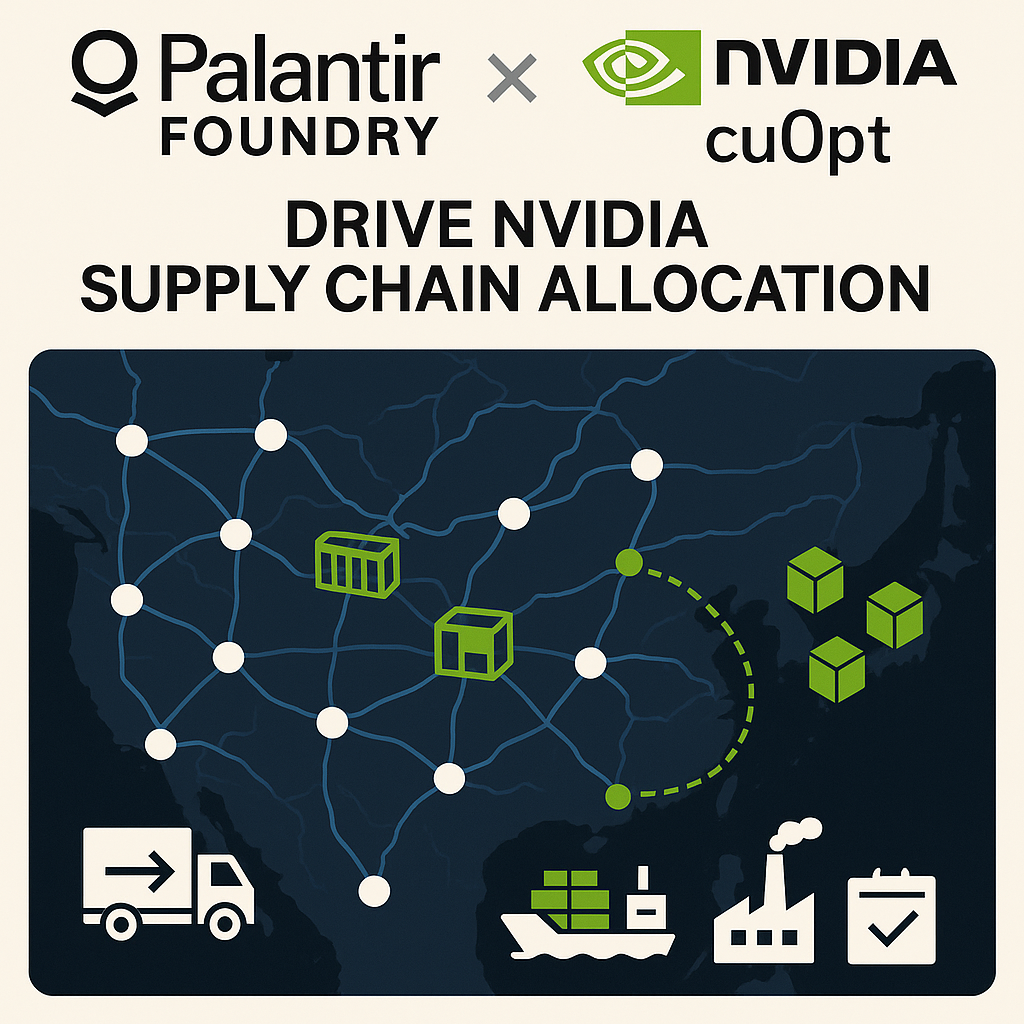
## Palantir Foundry and NVIDIA cuOpt Power Smarter Supply Chain Allocation for AI Hardware
NVIDIA is using Palantir Foundry alongside NVIDIA cuOpt to improve how it manages hardware supply chain allocation across its global manufacturing network. As demand for AI infrastructure continues to surge, the ability to move hardware efficiently from production to deployment has become a critical competitive advantage.
The company is reportedly focusing on a key operational metric: the time from “wafer-out” to “first token.” In simple terms, this measures how long it takes for chips leaving the fabrication stage to become part of a fully operational AI system capable of running workloads.
This process is divided into two major stages:
1. **Time-to-rack**
This covers the journey from semiconductor output to a fully assembled data centre system. It includes manufacturing, transportation, assembly, and installation into racks.
2. **Time-to-token**
This goes beyond physical deployment. It includes the work required to bring systems online, such as power provisioning, cooling, networking, configuration, and day-one software readiness.
By using Palantir Foundry, NVIDIA can bring together complex supply chain data from multiple sources into a unified operational platform. Foundry helps organisations model, analyse, and act on large volumes of data, which is especially useful in a global hardware supply chain where decisions depend on constantly changing constraints.
NVIDIA cuOpt adds another layer of intelligence by helping optimise allocation and routing decisions. cuOpt is designed to solve complex optimisation problems, making it useful for determining how hardware, components, and capacity should be assigned across factories, logistics networks, and deployment sites.
Together, Palantir Foundry and cuOpt can help NVIDIA make faster and more informed decisions about where hardware should go, how resources should be prioritised, and how bottlenecks can be reduced. This is particularly important as AI data centres become larger, more complex, and more time-sensitive to deploy.
The move reflects a broader shift in the AI industry. Success is no longer defined only by chip performance or model capability. It also depends on how quickly companies can deliver complete, operational AI infrastructure at scale. For NVIDIA, reducing the time between manufacturing output and usable compute capacity can help customers bring AI systems online faster.
As AI adoption grows across cloud providers, enterprises, and governments, supply chain optimisation is becoming just as strategic as hardware innovation. NVIDIA’s use of Palantir Foundry and cuOpt shows how advanced data platforms and optimisation software are now playing a central role in the race to build and deploy AI infrastructure efficiently.
Leave a Reply