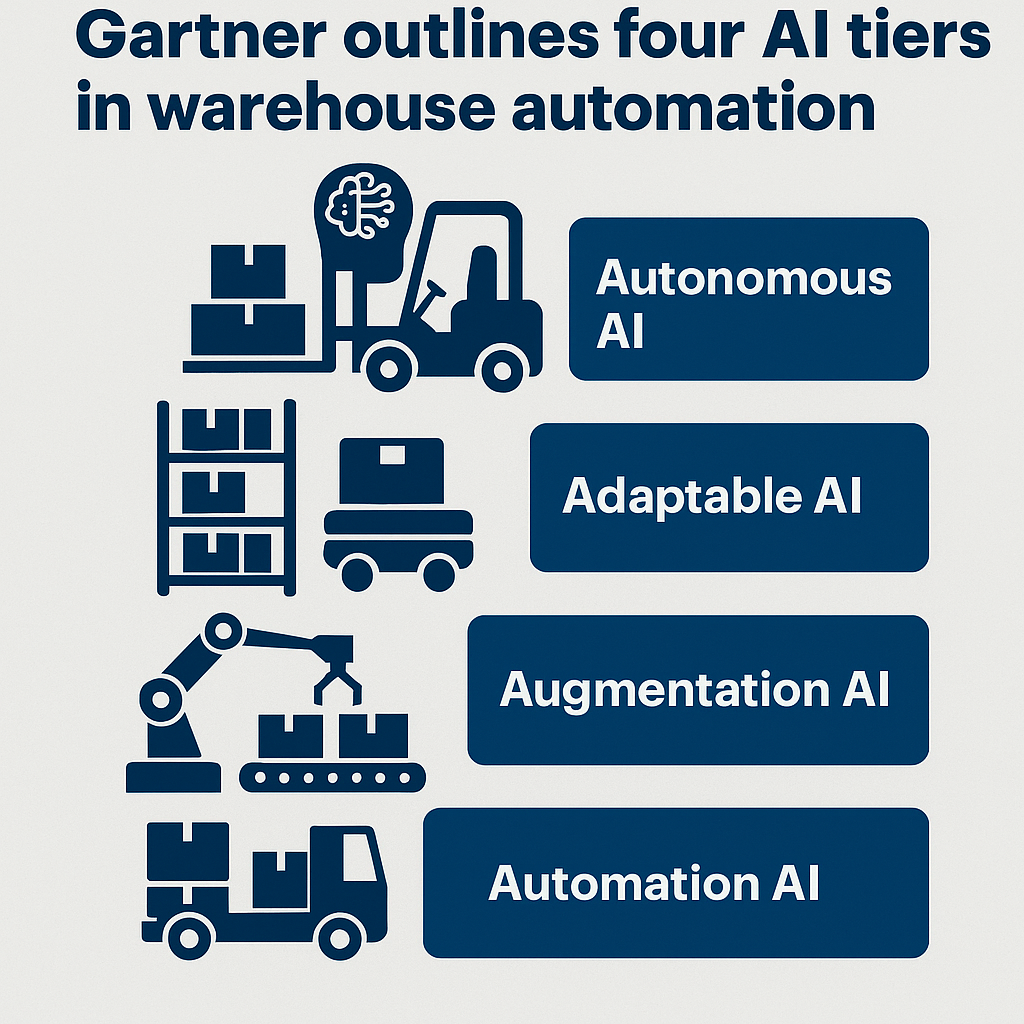
## Gartner Says Warehouse Automation Has Reached a New AI Adoption Threshold
Warehouse automation is moving beyond experimental software projects and entering a new phase of real-world deployment, according to a new analysis from Gartner. The research firm reports that logistics operators are now adopting artificial intelligence across four operational tiers, reflecting a broader shift from small-scale trials to live facility implementations.
The finding suggests that AI is no longer being treated as a future-facing concept in logistics. Instead, it is becoming a core part of warehouse strategy as companies look for ways to improve efficiency, reduce operational risk, and respond to ongoing workforce challenges.
### AI Moves From Pilot Projects to Practical Deployment
For years, many warehouse operators tested automation technologies in limited environments. These trials often focused on specific use cases such as inventory tracking, picking assistance, route optimisation, or robotic handling.
Gartner’s latest view indicates that the sector has crossed an important adoption threshold. More logistics businesses are now deploying AI-driven tools directly into active warehouse operations, where they support day-to-day decision-making and physical workflows.
This shift is significant because warehouses are complex environments. They must coordinate labour, inventory, equipment, transport schedules, and customer demand in real time. AI systems are increasingly being used to manage that complexity with greater speed and accuracy than traditional manual methods.
### Four AI Tiers Are Emerging in Warehouse Automation
Gartner describes warehouse automation as developing across four operational AI tiers. These tiers show how automation is progressing from basic support functions to more advanced operational intelligence.
At the lower end, AI may assist workers by improving visibility, forecasting demand, or recommending better task sequences. At more advanced levels, systems can coordinate robots, optimise warehouse flows, and make real-time operational decisions with limited human intervention.
This layered approach reflects the reality that not every warehouse will automate at the same pace. Some facilities may begin with AI-powered analytics or labour planning, while others may move more quickly toward robotics, autonomous mobile robots, and intelligent orchestration platforms.
### Labour Shortages Are Accelerating Automation
One of the biggest forces behind this change is the continuing shortage of warehouse workers. Many logistics operators are struggling to recruit and retain enough staff, especially during peak demand periods.
Persistent labour deficits are making automation more attractive. AI-powered systems can help warehouses maintain productivity even when staffing levels are under pressure. They can also reduce repetitive manual tasks, allowing human workers to focus on higher-value activities such as exception handling, quality control, and supervision.
Rather than replacing workers entirely, many automation strategies are focused on improving collaboration between people and machines. This includes tools that guide employees through tasks, robots that transport goods, and AI systems that help managers allocate labour more effectively.
### Logistics Operators Face Growing Pressure
The move toward warehouse AI is also being driven by wider industry pressures. Customers expect faster delivery, greater accuracy, and real-time visibility into orders. At the same time, companies must control costs and manage supply chain volatility.
Automation offers a way to respond to these demands. AI can help warehouses process orders faster, reduce errors, improve space utilisation, and adapt more quickly when demand changes.
For large logistics operators, even small improvements in picking efficiency, inventory accuracy, or equipment utilisation can produce major financial benefits. This is why AI adoption is becoming a strategic priority rather than just a technology upgrade.
### A New Phase for Smart Warehouses
Gartner’s analysis points to a future in which warehouses become increasingly intelligent, connected, and adaptive. AI will not only support individual tasks but also help coordinate entire facility operations.
As adoption grows, warehouse operators will need to focus on integration, data quality, workforce training, and change management. Successful automation depends not only on installing new technology but also on redesigning processes around it.
The key message is clear: warehouse automation has entered a more mature stage. AI is moving from trial environments into live logistics operations, and companies that invest early may gain a competitive advantage in speed, resilience, and efficiency.
Leave a Reply