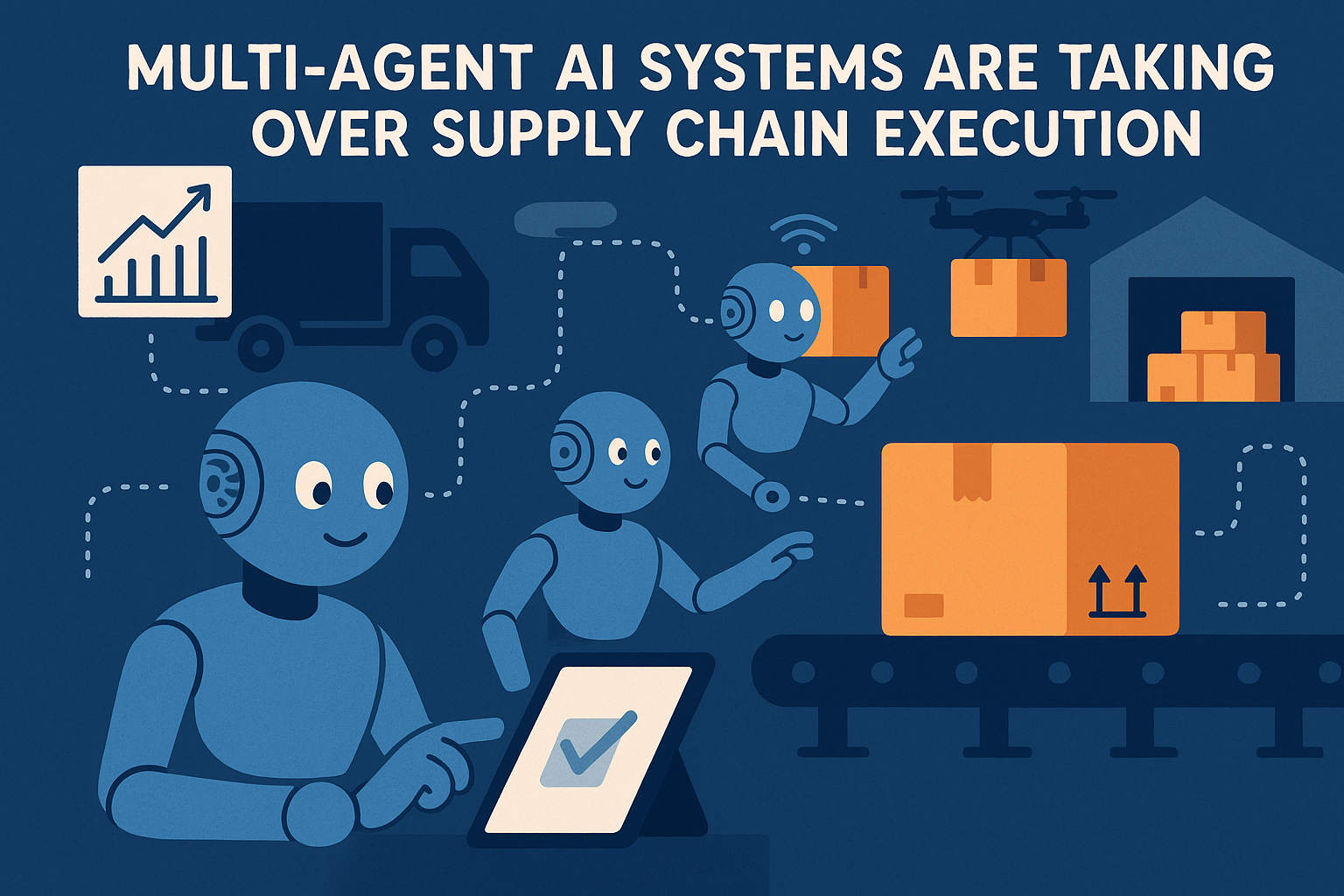
# Multi-Agent AI Systems Are Moving Supply Chains From Prediction to Autonomous Execution
Supply chain management is entering a new phase as companies look beyond traditional dashboards and recommendation engines. For years, enterprises have relied on predictive analytics to forecast demand, identify disruptions, and suggest operational changes. However, many of these systems still require human planners to review, approve, and execute every decision.
Now, multi-agent AI systems are beginning to change that model.
Instead of simply showing insights, these systems can coordinate actions across specific areas of supply chain execution. They are designed to operate within defined boundaries, allowing independent AI agents to make decisions, trigger workflows, and respond to changing conditions faster than manual planning cycles.
## From Static Dashboards to Autonomous Action
Traditional supply chain tools often depend on static dashboards and scheduled planning processes. A demand forecast may indicate that inventory should be moved, production should be adjusted, or transportation routes should be changed — but the final action usually waits for human approval.
This creates delays, especially in fast-moving environments where demand shifts, supplier issues, transport disruptions, or warehouse constraints can happen at any time.
Multi-agent AI systems aim to close that gap. Rather than waiting for weekly scheduling runs or manual intervention, specialized AI agents can monitor operational data continuously and act when certain conditions are met.
For example, one agent may track demand signals, another may monitor warehouse capacity, while another manages transport availability. Together, they can coordinate decisions such as reallocating stock, updating delivery schedules, or flagging supplier risks before they escalate.
## Why Supply Chain Leaders Are Paying Attention
Logistics directors and supply chain executives are under pressure to improve speed, resilience, and efficiency. Many organizations have already invested heavily in analytics platforms, but dashboards alone are no longer enough.
The challenge is not simply knowing what should happen — it is making it happen quickly and accurately.
Multi-agent AI offers a potential solution by shifting supply chains from a recommendation-based model to an execution-based model. This means AI is not only identifying problems but also helping resolve them within approved operational limits.
The benefits may include:
– Faster response to demand changes
– Reduced manual approval delays
– Better coordination between planning, logistics, and inventory teams
– Improved use of warehouse and transport capacity
– More resilient operations during disruptions
– Lower dependence on weekly or monthly planning cycles
## Human Oversight Is Still Important
Although multi-agent systems can automate decisions, they are not expected to remove humans entirely from supply chain management. Instead, human teams are likely to focus more on supervision, exception handling, strategy, and governance.
The most successful deployments will probably involve clear boundaries. For instance, AI agents may be allowed to adjust delivery schedules, recommend supplier alternatives, or rebalance inventory within set cost and risk limits. Larger or higher-risk decisions may still require human approval.
This approach allows companies to gain the speed of automation while maintaining control over critical business decisions.
## A Major Shift in Supply Chain Technology
The rise of multi-agent AI represents a major shift in how enterprises think about supply chain execution. Predictive models helped companies understand what might happen next. Multi-agent systems go further by enabling automated responses to those predictions.
As supply chains become more complex and global networks face constant disruption, businesses are looking for systems that can adapt in real time. Static dashboards and manual processes are increasingly unable to keep pace with modern operational demands.
Multi-agent AI systems may become a key part of the next generation of supply chain management — where software agents collaborate, make decisions, and execute tasks across the network.
## The Future of Supply Chain Execution
The adoption of multi-agent AI is still developing, but its direction is clear. Supply chains are moving from visibility to action, and from human-led approvals to controlled autonomy.
For enterprise leaders, the opportunity is significant. Companies that successfully implement these systems could improve agility, reduce operational delays, and respond more effectively to market changes.
However, success will depend on strong data quality, clear governance, well-defined automation rules, and trust between human operators and AI systems.
Multi-agent AI is not just another analytics upgrade. It signals a broader transformation in supply chain execution — one where intelligent agents do not only recommend the next move, but help carry it out.
Leave a Reply