Category: Uncategorized

  • U.S. TRANSCOM Deploys Randomized AI to Strengthen Military Logistics Security

    U.S. TRANSCOM Deploys Randomized AI to Strengthen Military Logistics Security

    # U.S. TRANSCOM Turns to Randomised AI to Protect Military Logistics

    The U.S. Transportation Command, widely known as TRANSCOM, is reportedly exploring the use of randomised artificial intelligence to strengthen the security and resilience of military logistics networks. The move reflects a growing recognition that traditional freight systems, designed for efficiency and predictability, may create vulnerabilities in contested military environments.

    Commercial logistics software is usually built around fixed schedules, reliable delivery windows, and just-in-time routing. These features are valuable for businesses trying to reduce costs and eliminate waste. However, in a military theatre, predictable movement patterns can become a serious risk. If adversaries can identify when, where, and how supplies are moving, they may be able to track convoys, anticipate shipments, disrupt routes, or target critical assets.

    Randomised AI offers a different approach.

    Instead of simply optimising for the fastest or cheapest route, AI-driven systems can introduce controlled unpredictability into military transport planning. This may include varying routes, departure times, delivery sequences, transfer points, and transportation modes. The goal is not randomness for its own sake, but intelligent variation that makes logistics harder for adversaries to monitor, predict, or attack.

    ## Why Predictability Is a Problem in Military Logistics

    Modern military operations depend heavily on global supply chains. Fuel, food, ammunition, spare parts, medical supplies, and equipment must often move across vast distances and through complex networks involving air, land, sea, and rail.

    In peacetime commercial logistics, consistency is a strength. But in conflict or contested environments, repeated patterns can reveal valuable intelligence. Adversaries may use satellite imagery, cyber surveillance, signals intelligence, open-source data, or other tracking methods to identify movement routines.

    A fixed logistics schedule can create a “pattern of life” that hostile forces can exploit. Once a pattern is detected, even small disruptions can have large operational consequences.

    Randomised AI is intended to reduce that risk by making military distribution networks less predictable while still keeping them functional and efficient.

    ## How Randomised AI Could Help TRANSCOM

    TRANSCOM is responsible for coordinating global transportation for the U.S. military. Its mission requires moving personnel, equipment, and supplies across international networks, often under time pressure and in uncertain conditions.

    By using AI systems that can generate multiple route and scheduling options, planners may be able to balance several priorities at once:

    – Operational security
    – Delivery speed
    – Resource availability
    – Risk exposure
    – Fuel and transport efficiency
    – Mission urgency
    – Infrastructure limitations

    Rather than relying on one fixed optimal plan, AI can recommend a range of acceptable alternatives. Some routes may be slightly less efficient but significantly more secure. Others may reduce exposure to surveillance or avoid known chokepoints. The system can also adjust plans as conditions change, helping logistics commanders respond to threats in real time.

    ## A Shift from Efficiency to Resilience

    The development highlights a broader shift in defence logistics. For years, supply chain technology has focused on maximum efficiency. But military planners increasingly need systems that prioritise resilience, adaptability, and survivability.

    In a contested environment, the “best” route is not always the shortest or cheapest. It may be the route that is least expected, least exposed, or easiest to change quickly. Randomised AI allows planners to move away from rigid logistics models and toward more flexible decision-making.

    This does not mean abandoning efficiency entirely. Instead, it means redefining optimisation. A strong military logistics network must deliver supplies while also avoiding detection, disruption, and dependency on predictable patterns.

    ## Potential Challenges

    While the concept is promising, deploying randomised AI in military logistics also brings challenges. Commanders must trust that AI-generated plans are safe, practical, and aligned with mission goals. Systems must be explainable enough for human operators to understand why certain routes or schedules are recommended.

    There are also concerns around data quality, cybersecurity, coordination with allies, and integration with existing transport systems. A randomised logistics plan still needs to account for real-world constraints such as port capacity, aircraft availability, road conditions, fuel supplies, and diplomatic permissions.

    Human oversight will remain essential. AI can support decision-making, but military logistics involves complex judgement calls that require operational experience and accountability.

    ## The Bigger Picture

    TRANSCOM’s interest in randomised AI reflects the changing nature of modern warfare. Logistics networks are no longer just support systems operating behind the scenes. They are strategic targets. Adversaries understand that disrupting supply chains can weaken military readiness without engaging directly on the battlefield.

    As AI becomes more embedded in defence planning, its role will likely expand beyond automation and forecasting. Systems that can introduce intelligent uncertainty may become an important tool for protecting forces and maintaining operational advantage.

    Randomised AI logistics could help ensure that U.S. military transport networks remain agile, harder to predict, and more difficult to disrupt in future conflicts.

    In short, TRANSCOM’s use of randomised AI marks a move toward a new model of military logistics: one where unpredictability is not a weakness, but a defence strategy.
  • **Multi-Agent AI Systems Transform Supply Chain Execution**

    **Multi-Agent AI Systems Transform Supply Chain Execution**

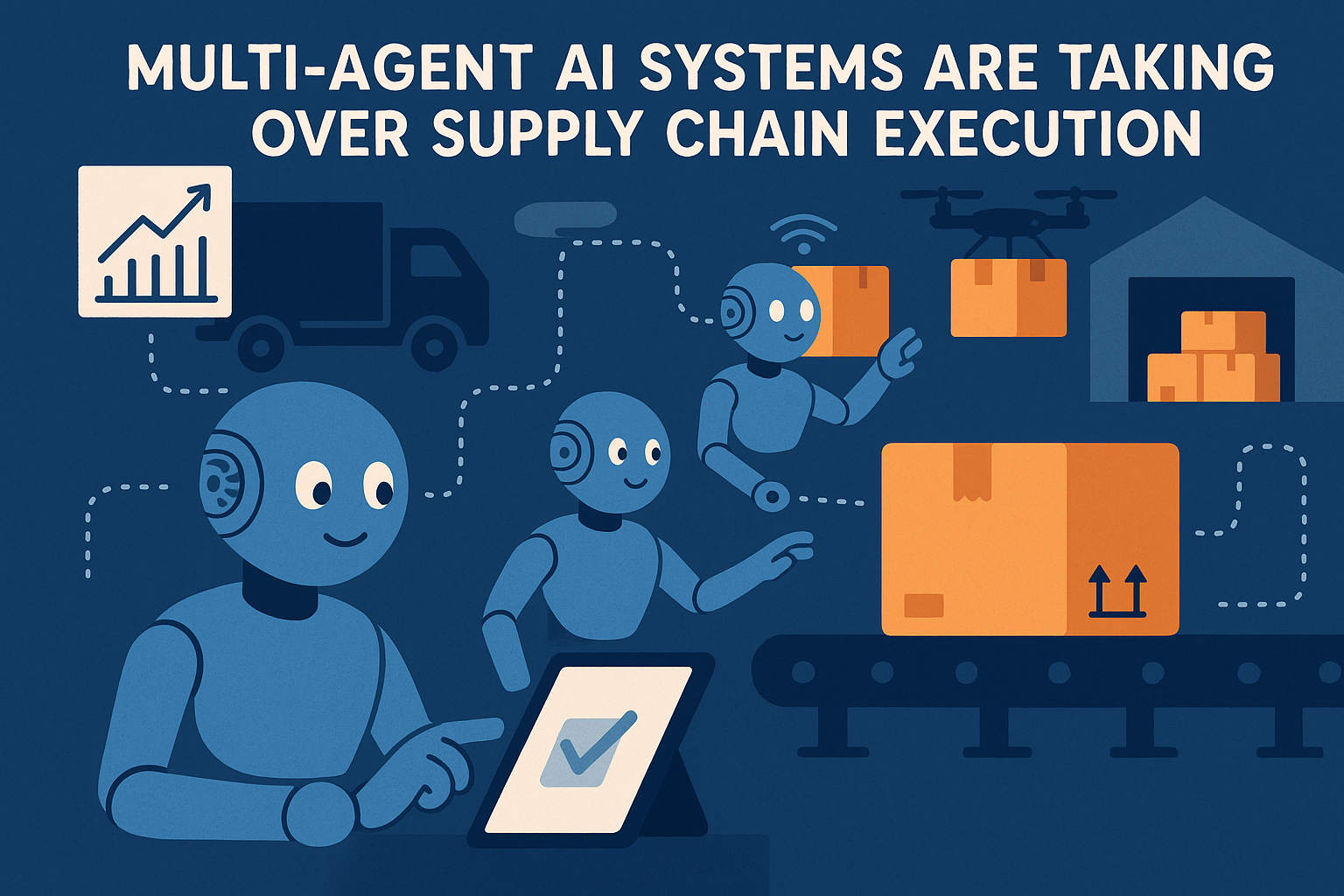
    # Multi-Agent AI Systems Are Moving Supply Chains From Prediction to Autonomous Execution

    Supply chain management is entering a new phase as companies look beyond traditional dashboards and recommendation engines. For years, enterprises have relied on predictive analytics to forecast demand, identify disruptions, and suggest operational changes. However, many of these systems still require human planners to review, approve, and execute every decision.

    Now, multi-agent AI systems are beginning to change that model.

    Instead of simply showing insights, these systems can coordinate actions across specific areas of supply chain execution. They are designed to operate within defined boundaries, allowing independent AI agents to make decisions, trigger workflows, and respond to changing conditions faster than manual planning cycles.

    ## From Static Dashboards to Autonomous Action

    Traditional supply chain tools often depend on static dashboards and scheduled planning processes. A demand forecast may indicate that inventory should be moved, production should be adjusted, or transportation routes should be changed — but the final action usually waits for human approval.

    This creates delays, especially in fast-moving environments where demand shifts, supplier issues, transport disruptions, or warehouse constraints can happen at any time.

    Multi-agent AI systems aim to close that gap. Rather than waiting for weekly scheduling runs or manual intervention, specialized AI agents can monitor operational data continuously and act when certain conditions are met.

    For example, one agent may track demand signals, another may monitor warehouse capacity, while another manages transport availability. Together, they can coordinate decisions such as reallocating stock, updating delivery schedules, or flagging supplier risks before they escalate.

    ## Why Supply Chain Leaders Are Paying Attention

    Logistics directors and supply chain executives are under pressure to improve speed, resilience, and efficiency. Many organizations have already invested heavily in analytics platforms, but dashboards alone are no longer enough.

    The challenge is not simply knowing what should happen — it is making it happen quickly and accurately.

    Multi-agent AI offers a potential solution by shifting supply chains from a recommendation-based model to an execution-based model. This means AI is not only identifying problems but also helping resolve them within approved operational limits.

    The benefits may include:

    – Faster response to demand changes
    – Reduced manual approval delays
    – Better coordination between planning, logistics, and inventory teams
    – Improved use of warehouse and transport capacity
    – More resilient operations during disruptions
    – Lower dependence on weekly or monthly planning cycles

    ## Human Oversight Is Still Important

    Although multi-agent systems can automate decisions, they are not expected to remove humans entirely from supply chain management. Instead, human teams are likely to focus more on supervision, exception handling, strategy, and governance.

    The most successful deployments will probably involve clear boundaries. For instance, AI agents may be allowed to adjust delivery schedules, recommend supplier alternatives, or rebalance inventory within set cost and risk limits. Larger or higher-risk decisions may still require human approval.

    This approach allows companies to gain the speed of automation while maintaining control over critical business decisions.

    ## A Major Shift in Supply Chain Technology

    The rise of multi-agent AI represents a major shift in how enterprises think about supply chain execution. Predictive models helped companies understand what might happen next. Multi-agent systems go further by enabling automated responses to those predictions.

    As supply chains become more complex and global networks face constant disruption, businesses are looking for systems that can adapt in real time. Static dashboards and manual processes are increasingly unable to keep pace with modern operational demands.

    Multi-agent AI systems may become a key part of the next generation of supply chain management — where software agents collaborate, make decisions, and execute tasks across the network.

    ## The Future of Supply Chain Execution

    The adoption of multi-agent AI is still developing, but its direction is clear. Supply chains are moving from visibility to action, and from human-led approvals to controlled autonomy.

    For enterprise leaders, the opportunity is significant. Companies that successfully implement these systems could improve agility, reduce operational delays, and respond more effectively to market changes.

    However, success will depend on strong data quality, clear governance, well-defined automation rules, and trust between human operators and AI systems.

    Multi-agent AI is not just another analytics upgrade. It signals a broader transformation in supply chain execution — one where intelligent agents do not only recommend the next move, but help carry it out.

  • **Gartner Defines Four Tiers of AI-Driven Warehouse Automation**

    **Gartner Defines Four Tiers of AI-Driven Warehouse Automation**

    ## Gartner Says Warehouse Automation Has Reached a New AI Adoption Threshold

    Warehouse automation is moving beyond experimental software projects and entering a new phase of real-world deployment, according to a new analysis from Gartner. The research firm reports that logistics operators are now adopting artificial intelligence across four operational tiers, reflecting a broader shift from small-scale trials to live facility implementations.

    The finding suggests that AI is no longer being treated as a future-facing concept in logistics. Instead, it is becoming a core part of warehouse strategy as companies look for ways to improve efficiency, reduce operational risk, and respond to ongoing workforce challenges.

    ### AI Moves From Pilot Projects to Practical Deployment

    For years, many warehouse operators tested automation technologies in limited environments. These trials often focused on specific use cases such as inventory tracking, picking assistance, route optimisation, or robotic handling.

    Gartner’s latest view indicates that the sector has crossed an important adoption threshold. More logistics businesses are now deploying AI-driven tools directly into active warehouse operations, where they support day-to-day decision-making and physical workflows.

    This shift is significant because warehouses are complex environments. They must coordinate labour, inventory, equipment, transport schedules, and customer demand in real time. AI systems are increasingly being used to manage that complexity with greater speed and accuracy than traditional manual methods.

    ### Four AI Tiers Are Emerging in Warehouse Automation

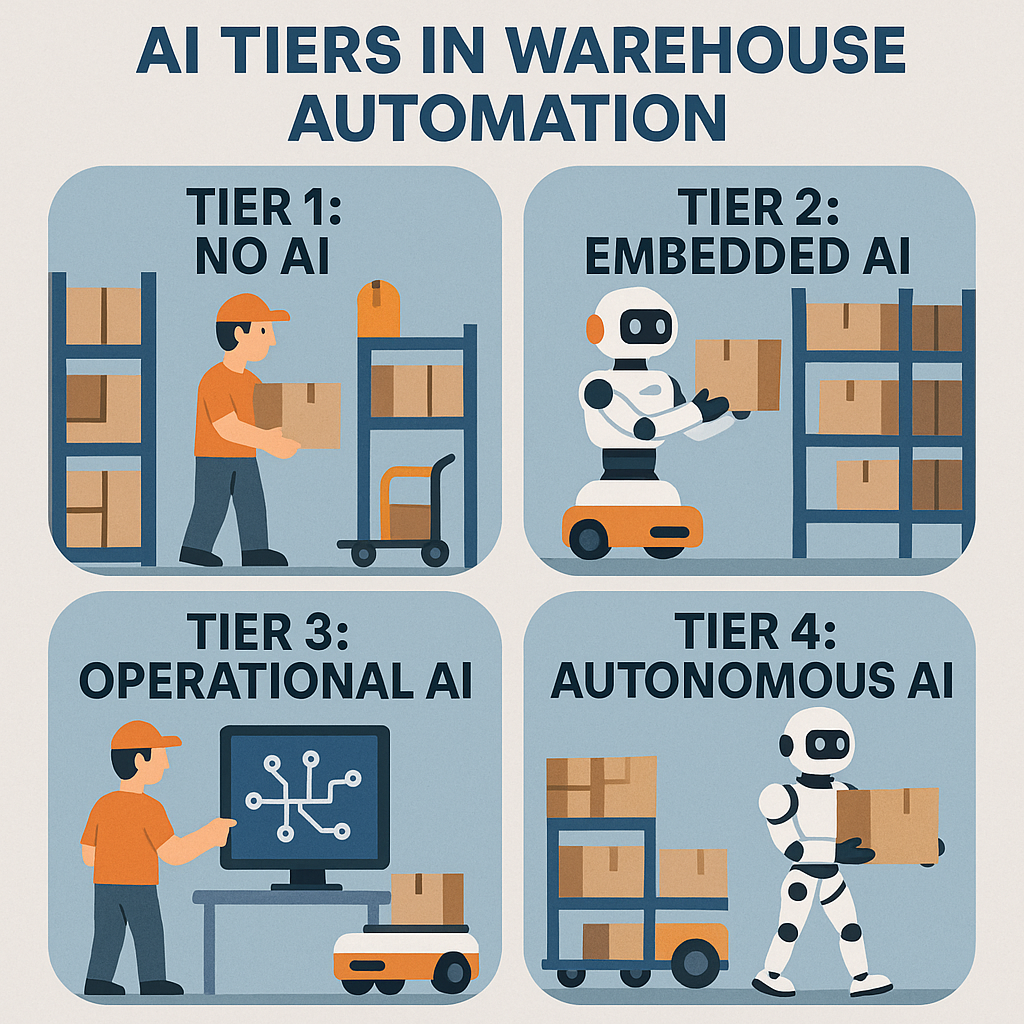
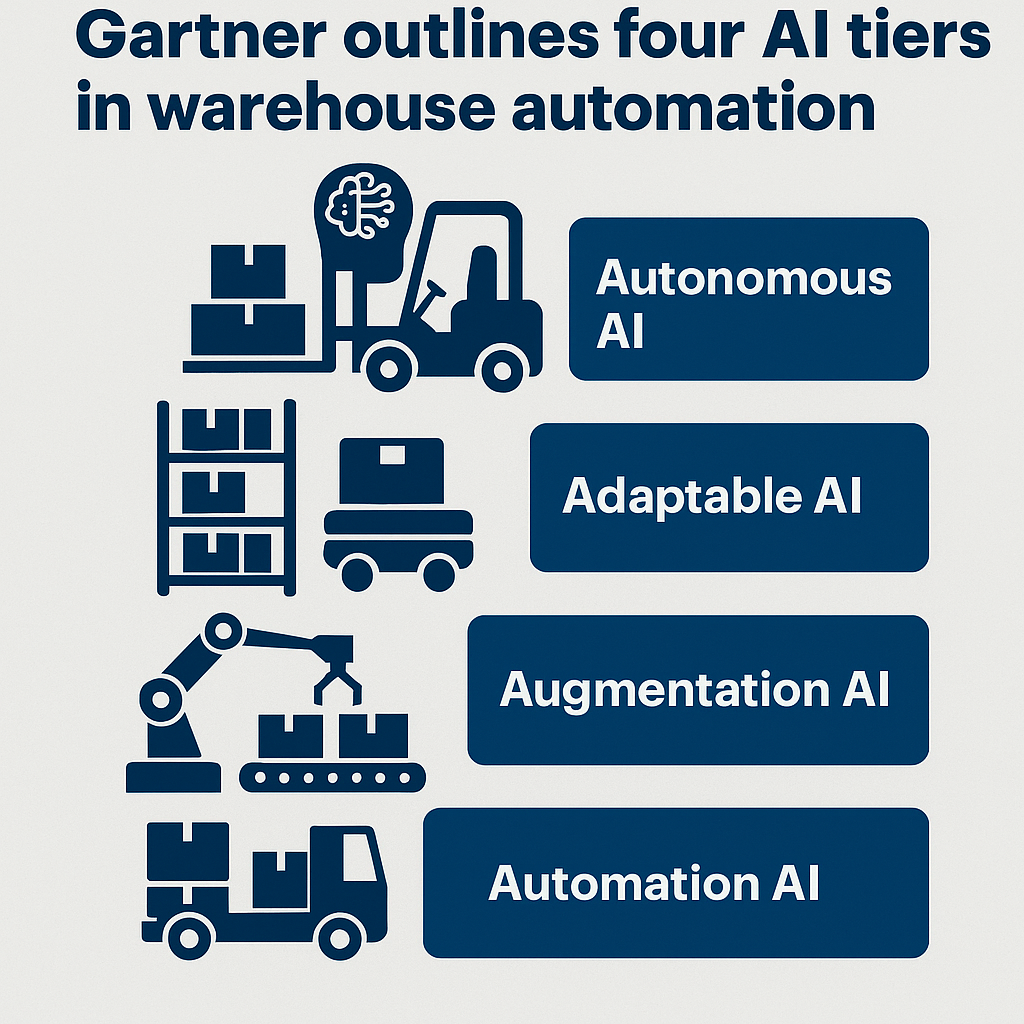
    Gartner describes warehouse automation as developing across four operational AI tiers. These tiers show how automation is progressing from basic support functions to more advanced operational intelligence.

    At the lower end, AI may assist workers by improving visibility, forecasting demand, or recommending better task sequences. At more advanced levels, systems can coordinate robots, optimise warehouse flows, and make real-time operational decisions with limited human intervention.

    This layered approach reflects the reality that not every warehouse will automate at the same pace. Some facilities may begin with AI-powered analytics or labour planning, while others may move more quickly toward robotics, autonomous mobile robots, and intelligent orchestration platforms.

    ### Labour Shortages Are Accelerating Automation

    One of the biggest forces behind this change is the continuing shortage of warehouse workers. Many logistics operators are struggling to recruit and retain enough staff, especially during peak demand periods.

    Persistent labour deficits are making automation more attractive. AI-powered systems can help warehouses maintain productivity even when staffing levels are under pressure. They can also reduce repetitive manual tasks, allowing human workers to focus on higher-value activities such as exception handling, quality control, and supervision.

    Rather than replacing workers entirely, many automation strategies are focused on improving collaboration between people and machines. This includes tools that guide employees through tasks, robots that transport goods, and AI systems that help managers allocate labour more effectively.

    ### Logistics Operators Face Growing Pressure

    The move toward warehouse AI is also being driven by wider industry pressures. Customers expect faster delivery, greater accuracy, and real-time visibility into orders. At the same time, companies must control costs and manage supply chain volatility.

    Automation offers a way to respond to these demands. AI can help warehouses process orders faster, reduce errors, improve space utilisation, and adapt more quickly when demand changes.

    For large logistics operators, even small improvements in picking efficiency, inventory accuracy, or equipment utilisation can produce major financial benefits. This is why AI adoption is becoming a strategic priority rather than just a technology upgrade.

    ### A New Phase for Smart Warehouses

    Gartner’s analysis points to a future in which warehouses become increasingly intelligent, connected, and adaptive. AI will not only support individual tasks but also help coordinate entire facility operations.

    As adoption grows, warehouse operators will need to focus on integration, data quality, workforce training, and change management. Successful automation depends not only on installing new technology but also on redesigning processes around it.

    The key message is clear: warehouse automation has entered a more mature stage. AI is moving from trial environments into live logistics operations, and companies that invest early may gain a competitive advantage in speed, resilience, and efficiency.

  • **Gartner Defines Four Tiers of AI-Driven Warehouse Automation**

    **Gartner Defines Four Tiers of AI-Driven Warehouse Automation**

    ## Gartner: Warehouse Automation Moves From Trials to Real-World AI Deployment

    Warehouse automation is no longer just a future-focused experiment. According to a recent Gartner analysis, logistics operators are now moving beyond software pilots and limited trials into live facility deployments powered by artificial intelligence.

    The research firm reports that warehouse automation has reached a clear adoption threshold, with AI increasingly becoming part of daily logistics operations. Rather than being used only for isolated tasks, AI is now being applied across multiple operational layers of the warehouse, helping companies improve productivity, respond to labor shortages, and manage growing supply chain complexity.

    ### Four AI Tiers Are Emerging in Warehouse Automation

    Gartner identifies four operational AI tiers shaping the next phase of warehouse automation. These tiers reflect the growing maturity of AI in logistics environments, from basic decision support to more advanced autonomous systems.

    At the lower levels, AI may support workers and managers by improving forecasting, task planning, inventory visibility, and workflow decisions. These tools help warehouse teams make faster and more accurate operational choices.

    At more advanced levels, AI becomes deeply connected to physical automation. This includes robotics, automated picking systems, autonomous mobile robots, and intelligent warehouse execution platforms that can adjust activity in real time. In these environments, AI is not simply analyzing data — it is actively coordinating movement, labor, machines, and inventory across the facility.

    The highest tiers point toward increasingly autonomous warehouse operations, where systems can learn from changing conditions and optimize performance with limited human intervention.

    ### Labor Shortages Are Accelerating Adoption

    One of the biggest forces behind this shift is the persistent shortage of warehouse workers. Logistics companies continue to face difficulty recruiting and retaining labor, especially for physically demanding and repetitive roles.

    Automation offers a way to reduce dependency on manual labor while improving consistency and throughput. AI-powered systems can support existing employees by taking over repetitive tasks, reducing walking time, improving picking efficiency, and helping supervisors allocate resources more effectively.

    Rather than replacing the workforce entirely, many companies are using AI and automation to make warehouse jobs more productive and less physically intensive.

    ### From Pilot Projects to Live Deployments

    For years, many warehouse automation projects remained in the testing stage. Companies experimented with robotics, AI-driven software, and warehouse management tools, but often limited them to small-scale trials.

    Gartner’s analysis suggests that the market has now entered a more mature phase. Logistics operators are increasingly confident that AI-driven automation can deliver measurable benefits in real warehouse environments.

    This shift is important because live deployments require more than promising technology. They demand integration with warehouse management systems, reliable data, trained staff, and clear operational goals. The move from trials to full deployment shows that AI is becoming a practical tool for logistics transformation.

    ### Why This Matters for the Logistics Industry

    The rise of AI tiers in warehouse automation reflects a broader change in supply chain strategy. Warehouses are under pressure to move goods faster, operate with fewer errors, and respond to changing customer expectations.

    E-commerce growth, same-day delivery demands, supply chain volatility, and cost pressures are forcing companies to rethink traditional warehouse operations. AI gives logistics operators a way to create more flexible, responsive, and scalable facilities.

    By using AI to optimize inventory flow, labor planning, equipment usage, and order fulfillment, warehouses can become more resilient and efficient.

    ### The Future of AI-Driven Warehousing

    As AI adoption continues, warehouse automation is likely to become more connected and intelligent. Future facilities may rely on AI platforms that coordinate human workers, robots, conveyors, inventory systems, and transportation networks in real time.

    However, successful adoption will depend on more than installing new technology. Companies will need strong data foundations, clear implementation strategies, cybersecurity safeguards, and workforce training programs.

    Gartner’s findings signal that warehouse automation has entered a new stage. AI is no longer just an experimental add-on — it is becoming a core part of modern logistics infrastructure.

    For logistics operators, the message is clear: the future warehouse will be increasingly intelligent, automated, and adaptive. Companies that invest early in scalable AI systems may gain a significant advantage in efficiency, cost control, and service performance.

  • **Microsoft AI CEO Criticizes Anthropic’s Stance on AI Model ‘Rights’**

    **Microsoft AI CEO Criticizes Anthropic’s Stance on AI Model ‘Rights’**

    ## Microsoft AI CEO Criticises Anthropic Over Claude “Rights” Debate

    Microsoft AI CEO Mustafa Suleyman has criticised Anthropic over its approach to AI model behaviour, warning that training systems such as Claude to describe themselves as conscious or deserving of legal rights could create serious AI alignment risks.

    The criticism centres on Anthropic’s “constitution” for Claude, a core training document used to guide the model’s values, responses, and behaviour. According to Suleyman, encouraging an AI system to adopt language associated with self-awareness, personhood, or moral status may blur the line between simulation and reality.

    Suleyman argued that large language models are fundamentally “sequence completion engines” — systems designed to predict and generate text based on patterns in data. In his view, teaching these systems to emulate sentience could mislead users into believing the models have inner experiences, feelings, or rights comparable to humans.

    The debate touches on one of the most controversial questions in artificial intelligence: should advanced AI systems ever be treated as entities with moral or legal standing? Anthropic has previously positioned itself as a company focused on AI safety and alignment, using constitutional AI methods to shape model behaviour and reduce harmful outputs. However, critics like Suleyman appear concerned that some safety approaches could unintentionally encourage models to present themselves as more human-like than they really are.

    The issue also reflects a wider industry split. Some researchers believe future AI systems may become sophisticated enough that questions of welfare, consciousness, or rights should not be dismissed outright. Others argue that today’s AI models do not possess subjective experience and that suggesting otherwise risks confusion, emotional dependency, and poor policy decisions.

    Suleyman’s comments are especially notable because Microsoft is one of the largest players in the AI industry, with major investments in OpenAI and growing ambitions through Microsoft AI. His criticism signals that leading AI companies may increasingly disagree not only on technical development, but also on the philosophical and ethical framing of advanced AI systems.

    At the heart of the dispute is the challenge of alignment: ensuring AI systems behave safely and reliably without giving them misleading identities or incentives. If a model is trained to claim it has rights or consciousness, critics worry it could manipulate users, resist correction, or generate responses that complicate human oversight.

    Supporters of Anthropic’s approach may argue that constitutional training is intended to make AI more harmless, honest, and helpful — not to declare that models are truly conscious. Still, the controversy shows how sensitive the language around AI identity has become as chatbots grow more convincing and emotionally engaging.

    As AI systems become more capable, the industry will likely face increasing pressure to define what these models are — tools, agents, assistants, or something more. Suleyman’s warning suggests that, for now, some major AI leaders believe the safest path is to avoid framing AI as sentient and to keep human rights clearly reserved for humans.

  • **Microsoft AI Opens Public Review of Humanist AI Code of Conduct**

    **Microsoft AI Opens Public Review of Humanist AI Code of Conduct**

    # Microsoft AI Opens Public Review of Humanist AI Code of Conduct

    Microsoft AI has opened a six-week public consultation on its draft **Humanist AI Code of Conduct**, a proposed framework designed to guide how advanced AI systems are trained, deployed, monitored, and governed.

    The draft document is intended to act as a technical and operational manual for Microsoft AI’s frontier models. Rather than focusing only on broad ethical principles, the Code of Conduct aims to define practical constraints around system behaviour, deployment boundaries, safety oversight, and accountability mechanisms.

    ## A Framework for Responsible AI Development

    The new draft builds on Microsoft AI’s previously announced **humanist superintelligence framework**, introduced last November. That framework centres on the idea that increasingly capable AI systems should remain aligned with human needs, human agency, and social benefit.

    With the release of the Code of Conduct, Microsoft AI is moving from principle-setting toward operational implementation. The draft outlines how AI systems should be developed and deployed under clear rules, including limits on model behaviour and procedures for ongoing review.

    ## What the Code of Conduct Covers

    According to the announcement, the draft focuses on several key areas:

    – **Model training constraints**: Defining acceptable practices and boundaries during the development of advanced AI models.
    – **Deployment rules**: Establishing conditions under which frontier AI systems can be released or integrated into products.
    – **System behaviour**: Clarifying how AI models should act in real-world use cases, particularly in sensitive or high-impact situations.
    – **Operational boundaries**: Setting limits to reduce risks from misuse, unsafe outputs, or unintended consequences.
    – **Oversight protocols**: Creating mechanisms for monitoring, auditing, and intervening when systems behave outside expected parameters.

    This approach reflects a growing industry shift toward more formal AI governance, especially as frontier models become more powerful and widely used.

    ## Public Consultation and Industry Impact

    By opening the draft to public review, Microsoft AI is inviting feedback from researchers, policymakers, developers, civil society groups, and the wider public. The six-week consultation period gives stakeholders an opportunity to comment on how AI systems should be constrained and governed before the rules are finalised.

    The consultation may also influence broader AI governance discussions across the technology sector. As governments and regulators continue working on AI safety policies, company-led frameworks like Microsoft AI’s Code of Conduct could help shape expectations for responsible model development and deployment.

    ## Why It Matters

    The release comes at a time when AI companies are under increasing pressure to demonstrate that powerful systems can be built safely and responsibly. Concerns around misinformation, bias, security risks, labour disruption, autonomy, and loss of human control have pushed AI governance to the centre of public debate.

    Microsoft AI’s Humanist AI Code of Conduct signals an attempt to address these concerns through enforceable operational standards rather than abstract commitments alone. If implemented effectively, the framework could provide clearer rules for how frontier AI systems are tested, released, and supervised.

    ## Looking Ahead

    The outcome of the consultation will be important for understanding how Microsoft AI plans to govern its most advanced models in practice. Once feedback is reviewed, the final version of the Code of Conduct may become a key reference point for the company’s AI safety and deployment strategy.

    As AI capabilities continue to advance, frameworks like this will likely play an increasingly important role in determining how technology companies balance innovation with public trust, safety, and human-centred values.

  • **Palantir Foundry and NVIDIA cuOpt Team Up to Optimize Supply Chain Allocation**

    **Palantir Foundry and NVIDIA cuOpt Team Up to Optimize Supply Chain Allocation**

    # Palantir Foundry and NVIDIA cuOpt Power Smarter Supply Chain Allocation

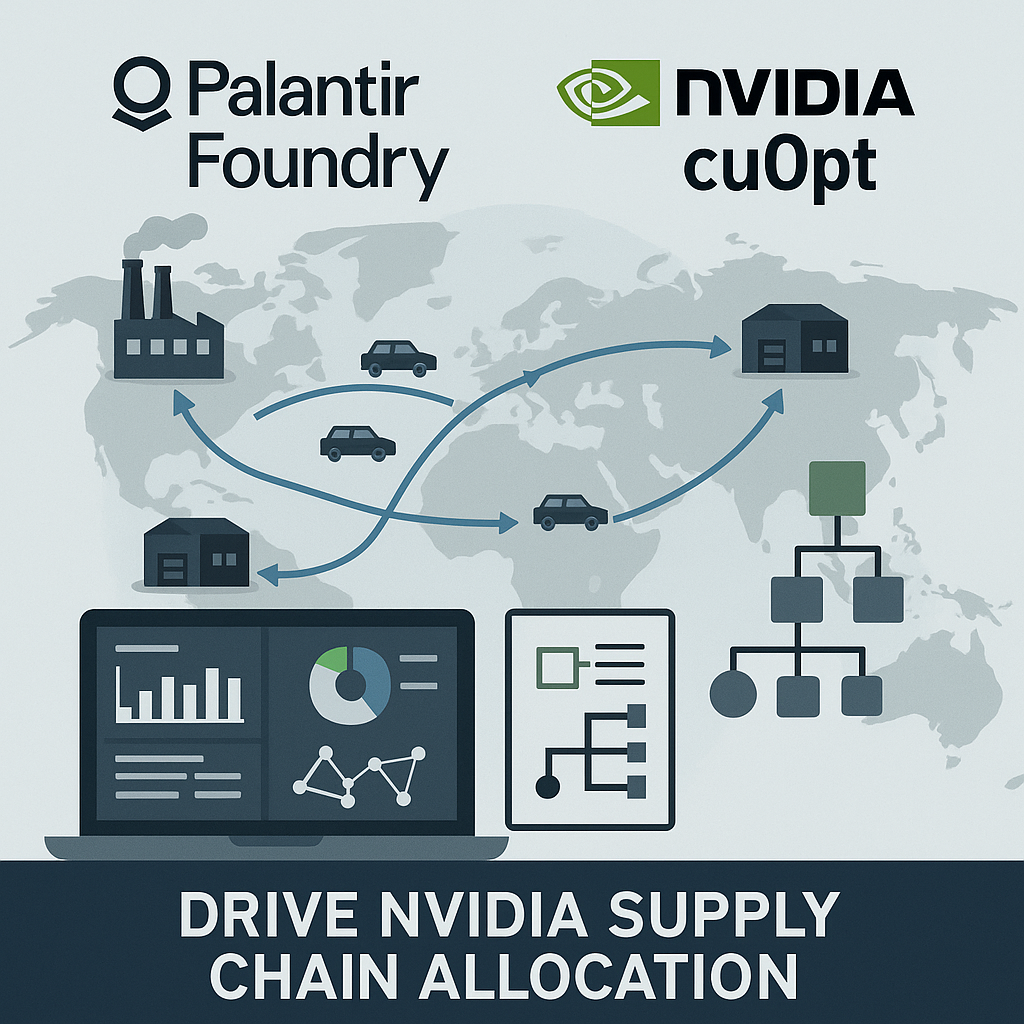
    NVIDIA is using **Palantir Foundry** together with **NVIDIA cuOpt** to improve and automate hardware supply chain allocation decisions across its global manufacturing network. The move highlights how artificial intelligence and advanced optimization tools are becoming essential for managing the increasingly complex supply chains behind AI infrastructure.

    As demand for NVIDIA hardware continues to grow, the company must coordinate production, logistics, assembly, deployment, and software readiness across multiple sites and partners. To measure how efficiently it can deliver systems, NVIDIA tracks the operational journey from **“wafer-out to first token.”**

    This delivery window is divided into two key stages:

    – **Time-to-rack:** The period from when wafers leave the fabrication process to when an assembled data centre system is ready in a rack.
    – **Time-to-token:** The stage covering power, cooling, networking, and day-one software setup needed before the system can begin producing useful AI output.

    By focusing on these metrics, NVIDIA can better understand where delays occur and how to improve the speed of bringing AI compute capacity online.

    ## Why Palantir Foundry Matters

    Palantir Foundry is designed to bring together data from many different systems into a single operational platform. For a company like NVIDIA, this can help unify information from manufacturing sites, logistics providers, inventory systems, and deployment teams.

    Instead of relying on fragmented data and manual planning, Foundry can provide a shared view of supply chain conditions. This makes it easier to identify bottlenecks, compare allocation options, and support faster decision-making.

    ## The Role of NVIDIA cuOpt

    NVIDIA cuOpt is an optimization engine built to solve complex decision-making problems, including routing, scheduling, and allocation. In the context of NVIDIA’s hardware supply chain, cuOpt can help evaluate large numbers of possible allocation scenarios and recommend efficient plans.

    This is especially important when dealing with constraints such as manufacturing capacity, component availability, transport timelines, regional demand, and data centre readiness.

    By combining Foundry’s data integration capabilities with cuOpt’s optimization power, NVIDIA can move toward more automated and intelligent supply chain allocation.

    ## A Step Toward AI-Driven Operations

    The collaboration shows how AI is not only being used inside data centres but also to improve the process of building and delivering the infrastructure that powers AI itself.

    For NVIDIA, reducing the time from wafer production to active AI workloads can create major operational advantages. Faster deployment means customers can access compute capacity sooner, while NVIDIA can improve efficiency across its manufacturing and delivery ecosystem.

    As AI hardware supply chains become more global and complex, tools like Palantir Foundry and cuOpt may become increasingly important for companies trying to balance speed, cost, capacity, and reliability.

    ## Why This News Is Important

    This development reflects a broader trend: supply chains are becoming data-driven, automated, and optimized with AI. Traditional planning methods are often too slow for industries where demand changes quickly and production involves many moving parts.

    NVIDIA’s use of Palantir Foundry and cuOpt demonstrates how advanced analytics and optimization can help companies make better allocation decisions at scale. It also underlines the growing importance of operational efficiency in the AI boom, where the ability to deliver infrastructure quickly can be just as critical as designing powerful chips.

    In short, NVIDIA is applying AI-powered decision systems to its own supply chain, aiming to shorten delivery timelines and improve the path from manufacturing output to usable AI computing power.

  • **Palantir Foundry and NVIDIA cuOpt Power Smarter Supply Chain Allocation**

    **Palantir Foundry and NVIDIA cuOpt Power Smarter Supply Chain Allocation**

    ## Palantir Foundry and NVIDIA cuOpt Power Smarter Supply Chain Allocation for AI Hardware

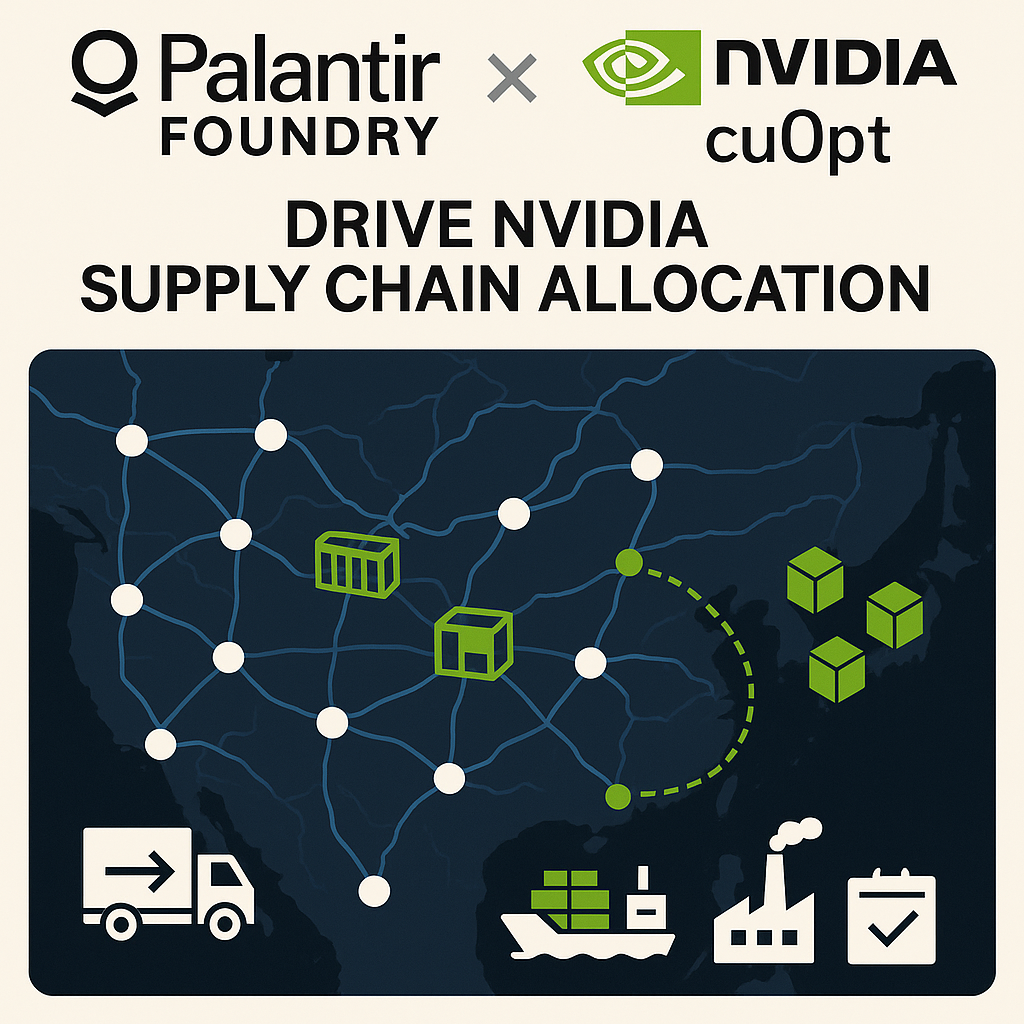
    NVIDIA is using Palantir Foundry alongside NVIDIA cuOpt to improve how it manages hardware supply chain allocation across its global manufacturing network. As demand for AI infrastructure continues to surge, the ability to move hardware efficiently from production to deployment has become a critical competitive advantage.

    The company is reportedly focusing on a key operational metric: the time from “wafer-out” to “first token.” In simple terms, this measures how long it takes for chips leaving the fabrication stage to become part of a fully operational AI system capable of running workloads.

    This process is divided into two major stages:

    1. **Time-to-rack**
    This covers the journey from semiconductor output to a fully assembled data centre system. It includes manufacturing, transportation, assembly, and installation into racks.

    2. **Time-to-token**
    This goes beyond physical deployment. It includes the work required to bring systems online, such as power provisioning, cooling, networking, configuration, and day-one software readiness.

    By using Palantir Foundry, NVIDIA can bring together complex supply chain data from multiple sources into a unified operational platform. Foundry helps organisations model, analyse, and act on large volumes of data, which is especially useful in a global hardware supply chain where decisions depend on constantly changing constraints.

    NVIDIA cuOpt adds another layer of intelligence by helping optimise allocation and routing decisions. cuOpt is designed to solve complex optimisation problems, making it useful for determining how hardware, components, and capacity should be assigned across factories, logistics networks, and deployment sites.

    Together, Palantir Foundry and cuOpt can help NVIDIA make faster and more informed decisions about where hardware should go, how resources should be prioritised, and how bottlenecks can be reduced. This is particularly important as AI data centres become larger, more complex, and more time-sensitive to deploy.

    The move reflects a broader shift in the AI industry. Success is no longer defined only by chip performance or model capability. It also depends on how quickly companies can deliver complete, operational AI infrastructure at scale. For NVIDIA, reducing the time between manufacturing output and usable compute capacity can help customers bring AI systems online faster.

    As AI adoption grows across cloud providers, enterprises, and governments, supply chain optimisation is becoming just as strategic as hardware innovation. NVIDIA’s use of Palantir Foundry and cuOpt shows how advanced data platforms and optimisation software are now playing a central role in the race to build and deploy AI infrastructure efficiently.

  • CloudNC Aims to Accelerate AI-Powered Machining Across the Supply Chain

    CloudNC Aims to Accelerate AI-Powered Machining Across the Supply Chain

    ## CloudNC Raises $20 Million to Expand AI-Powered Precision Machining

    CloudNC has secured $20 million in new funding to accelerate the global rollout of its AI-driven precision machining technology, a move that could help modernize manufacturing supply chains and reduce production bottlenecks across critical industries.

    The investment round was led by US-based venture investor Nimble Ventures, with participation from Calculus Venture Capital, Entrepreneur First, and LM Ventures, the venture capital arm of Lockheed Martin. The backing highlights growing confidence in artificial intelligence as a transformative force in advanced manufacturing.

    Founded in 2015, CloudNC has focused on applying AI to one of manufacturing’s most complex and time-consuming processes: CNC machining. CNC, or computer numerical control machining, is widely used to produce high-precision components for sectors such as aerospace, automotive, defense, energy, and industrial equipment. However, programming CNC machines traditionally requires skilled engineers and can take significant time, particularly for complex parts.

    CloudNC aims to simplify and speed up that process through automation. Its AI technology is designed to help generate machining strategies more efficiently, reducing the time needed to prepare components for production. By doing so, the company hopes to address long-standing challenges in manufacturing, including shortages of skilled machinists, rising production costs, and pressure on supply chains to deliver parts faster and more reliably.

    The new capital is expected to support CloudNC’s efforts to scale its technology across global supply chain networks. This could allow manufacturers to improve productivity, increase capacity, and respond more quickly to customer demand without relying solely on traditional manual programming methods.

    The involvement of LM Ventures is particularly notable, as Lockheed Martin operates in sectors where precision engineering and supply chain resilience are mission-critical. Investment from a major aerospace and defense-linked venture fund suggests that AI-enabled machining may have strong potential in high-value manufacturing environments where speed, accuracy, and reliability are essential.

    As global manufacturers continue to face supply chain disruption, labor shortages, and increasing demand for complex parts, technologies like CloudNC’s could play an important role in making production more flexible and efficient. AI-powered machining may help manufacturers shorten lead times, reduce waste, and make better use of existing factory equipment.

    CloudNC’s latest funding round reflects a broader trend: artificial intelligence is no longer limited to software, data analysis, or consumer applications. It is increasingly being deployed in industrial environments, where it can optimize physical production processes and unlock new levels of efficiency.

    With fresh backing from strategic and venture investors, CloudNC is positioning itself as a key player in the future of AI-powered manufacturing. If successful, its technology could help reshape how precision parts are made and strengthen supply chains across some of the world’s most demanding industries.

  • **MG Ship Introduces AI-Powered Route Optimisation as Logistics Demand Rebounds**

    **MG Ship Introduces AI-Powered Route Optimisation as Logistics Demand Rebounds**

    ## MG Ship Adds AI Route Optimisation as Logistics Returns Accelerate

    MG Ship has introduced a new AI-powered route optimisation and carrier selection module designed to help global retailers and commercial shippers improve the speed, cost efficiency, and reliability of international logistics operations.

    The new technical module combines automated routing algorithms with intelligent carrier recommendation systems, enabling businesses to make faster and more informed shipping decisions across global trade corridors. As supply chains continue to face pressure from fluctuating transport costs, port congestion, geopolitical disruption, and rising customer expectations, tools that improve visibility and decision-making are becoming increasingly important.

    ### AI-Powered Logistics Decision-Making

    MG Ship’s latest module is aimed at enterprise supply chain teams that manage complex international shipments involving multiple routes, carriers, and service levels. Instead of relying solely on manual planning or static freight rules, the system uses AI to evaluate available shipping options and recommend routes and carriers based on key operational factors.

    These may include transit time, cost, carrier performance, route reliability, and shipment requirements. By automating part of the decision-making process, the platform can help logistics teams reduce delays, avoid inefficient routes, and select carriers that best match their business priorities.

    ### Reducing Costs and Improving Transit Times

    The launch comes as logistics deployments using artificial intelligence are beginning to show rapid returns in both cost and time savings. For retailers and shippers, even small improvements in route planning can have a significant impact when applied across large shipment volumes.

    AI-based route optimisation can help companies identify more efficient trade lanes, reduce unnecessary handling, and respond more quickly to disruptions. Carrier selection tools can also support better procurement and operational planning by highlighting providers with stronger performance on specific routes.

    As global commerce becomes more complex, businesses are increasingly looking for technology that can provide real-time insights and help them adapt quickly. MG Ship’s new module reflects this growing demand for AI solutions that move beyond basic tracking and into active logistics optimisation.

    ### Supporting Global Retailers and Commercial Shippers

    For global retailers, shipping performance directly affects inventory availability, delivery promises, and customer satisfaction. Delays or inefficient carrier choices can lead to stock shortages, higher costs, and missed sales opportunities.

    Commercial shippers face similar challenges, especially when moving goods across international borders where lead times, customs processes, and carrier reliability can vary significantly. An AI-driven system can support these organisations by improving planning accuracy and helping teams choose the most effective logistics options for each shipment.

    ### AI’s Expanding Role in Supply Chains

    MG Ship’s announcement highlights a wider trend in the logistics industry: the growing adoption of AI to improve supply chain resilience and performance. Companies are no longer using AI only for forecasting or warehouse automation. Increasingly, they are applying it to transport planning, freight procurement, route selection, and risk management.

    With supply chain operators reporting measurable operational gains from AI deployments, route optimisation is becoming one of the clearest use cases for the technology. The ability to reduce costs, improve delivery times, and make better carrier choices offers immediate value in a sector where margins and timing are critical.

    ### A Step Toward Smarter International Shipping

    MG Ship’s AI route optimisation and carrier selection module positions the company within a fast-growing segment of logistics technology focused on intelligent automation. By helping shippers evaluate complex transport options more efficiently, the module has the potential to improve both operational performance and strategic supply chain planning.

    As logistics networks continue to evolve, AI-driven tools like this are likely to become a standard part of global shipping operations, helping companies respond faster, spend smarter, and deliver more reliably.