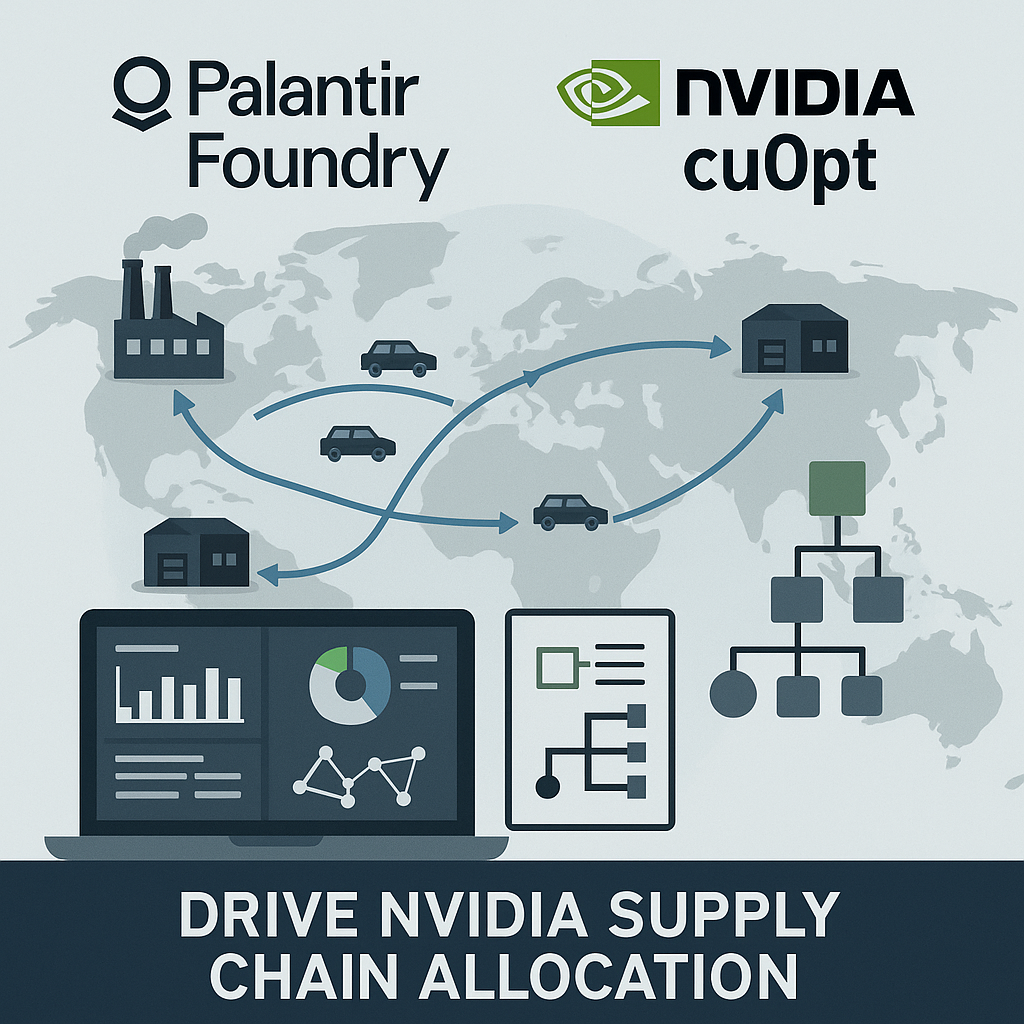
# Palantir Foundry and NVIDIA cuOpt Power Smarter Supply Chain Allocation
NVIDIA is using **Palantir Foundry** together with **NVIDIA cuOpt** to improve and automate hardware supply chain allocation decisions across its global manufacturing network. The move highlights how artificial intelligence and advanced optimization tools are becoming essential for managing the increasingly complex supply chains behind AI infrastructure.
As demand for NVIDIA hardware continues to grow, the company must coordinate production, logistics, assembly, deployment, and software readiness across multiple sites and partners. To measure how efficiently it can deliver systems, NVIDIA tracks the operational journey from **“wafer-out to first token.”**
This delivery window is divided into two key stages:
– **Time-to-rack:** The period from when wafers leave the fabrication process to when an assembled data centre system is ready in a rack.
– **Time-to-token:** The stage covering power, cooling, networking, and day-one software setup needed before the system can begin producing useful AI output.
By focusing on these metrics, NVIDIA can better understand where delays occur and how to improve the speed of bringing AI compute capacity online.
## Why Palantir Foundry Matters
Palantir Foundry is designed to bring together data from many different systems into a single operational platform. For a company like NVIDIA, this can help unify information from manufacturing sites, logistics providers, inventory systems, and deployment teams.
Instead of relying on fragmented data and manual planning, Foundry can provide a shared view of supply chain conditions. This makes it easier to identify bottlenecks, compare allocation options, and support faster decision-making.
## The Role of NVIDIA cuOpt
NVIDIA cuOpt is an optimization engine built to solve complex decision-making problems, including routing, scheduling, and allocation. In the context of NVIDIA’s hardware supply chain, cuOpt can help evaluate large numbers of possible allocation scenarios and recommend efficient plans.
This is especially important when dealing with constraints such as manufacturing capacity, component availability, transport timelines, regional demand, and data centre readiness.
By combining Foundry’s data integration capabilities with cuOpt’s optimization power, NVIDIA can move toward more automated and intelligent supply chain allocation.
## A Step Toward AI-Driven Operations
The collaboration shows how AI is not only being used inside data centres but also to improve the process of building and delivering the infrastructure that powers AI itself.
For NVIDIA, reducing the time from wafer production to active AI workloads can create major operational advantages. Faster deployment means customers can access compute capacity sooner, while NVIDIA can improve efficiency across its manufacturing and delivery ecosystem.
As AI hardware supply chains become more global and complex, tools like Palantir Foundry and cuOpt may become increasingly important for companies trying to balance speed, cost, capacity, and reliability.
## Why This News Is Important
This development reflects a broader trend: supply chains are becoming data-driven, automated, and optimized with AI. Traditional planning methods are often too slow for industries where demand changes quickly and production involves many moving parts.
NVIDIA’s use of Palantir Foundry and cuOpt demonstrates how advanced analytics and optimization can help companies make better allocation decisions at scale. It also underlines the growing importance of operational efficiency in the AI boom, where the ability to deliver infrastructure quickly can be just as critical as designing powerful chips.
In short, NVIDIA is applying AI-powered decision systems to its own supply chain, aiming to shorten delivery timelines and improve the path from manufacturing output to usable AI computing power.
Leave a Reply