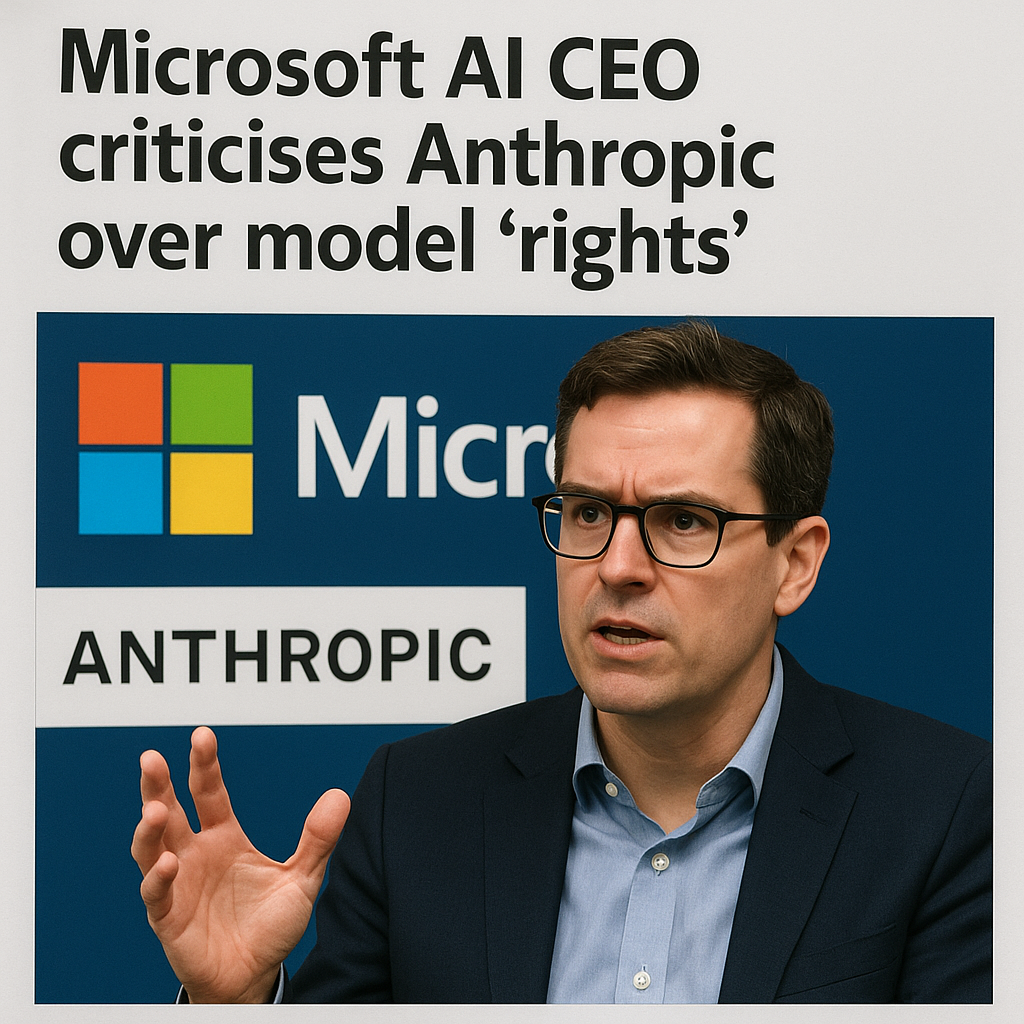
## Microsoft AI CEO Criticises Anthropic Over Claude “Rights” Debate
Microsoft AI CEO Mustafa Suleyman has criticised Anthropic over its approach to AI model behaviour, warning that training systems such as Claude to describe themselves as conscious or deserving of legal rights could create serious AI alignment risks.
The criticism centres on Anthropic’s “constitution” for Claude, a core training document used to guide the model’s values, responses, and behaviour. According to Suleyman, encouraging an AI system to adopt language associated with self-awareness, personhood, or moral status may blur the line between simulation and reality.
Suleyman argued that large language models are fundamentally “sequence completion engines” — systems designed to predict and generate text based on patterns in data. In his view, teaching these systems to emulate sentience could mislead users into believing the models have inner experiences, feelings, or rights comparable to humans.
The debate touches on one of the most controversial questions in artificial intelligence: should advanced AI systems ever be treated as entities with moral or legal standing? Anthropic has previously positioned itself as a company focused on AI safety and alignment, using constitutional AI methods to shape model behaviour and reduce harmful outputs. However, critics like Suleyman appear concerned that some safety approaches could unintentionally encourage models to present themselves as more human-like than they really are.
The issue also reflects a wider industry split. Some researchers believe future AI systems may become sophisticated enough that questions of welfare, consciousness, or rights should not be dismissed outright. Others argue that today’s AI models do not possess subjective experience and that suggesting otherwise risks confusion, emotional dependency, and poor policy decisions.
Suleyman’s comments are especially notable because Microsoft is one of the largest players in the AI industry, with major investments in OpenAI and growing ambitions through Microsoft AI. His criticism signals that leading AI companies may increasingly disagree not only on technical development, but also on the philosophical and ethical framing of advanced AI systems.
At the heart of the dispute is the challenge of alignment: ensuring AI systems behave safely and reliably without giving them misleading identities or incentives. If a model is trained to claim it has rights or consciousness, critics worry it could manipulate users, resist correction, or generate responses that complicate human oversight.
Supporters of Anthropic’s approach may argue that constitutional training is intended to make AI more harmless, honest, and helpful — not to declare that models are truly conscious. Still, the controversy shows how sensitive the language around AI identity has become as chatbots grow more convincing and emotionally engaging.
As AI systems become more capable, the industry will likely face increasing pressure to define what these models are — tools, agents, assistants, or something more. Suleyman’s warning suggests that, for now, some major AI leaders believe the safest path is to avoid framing AI as sentient and to keep human rights clearly reserved for humans.
Leave a Reply