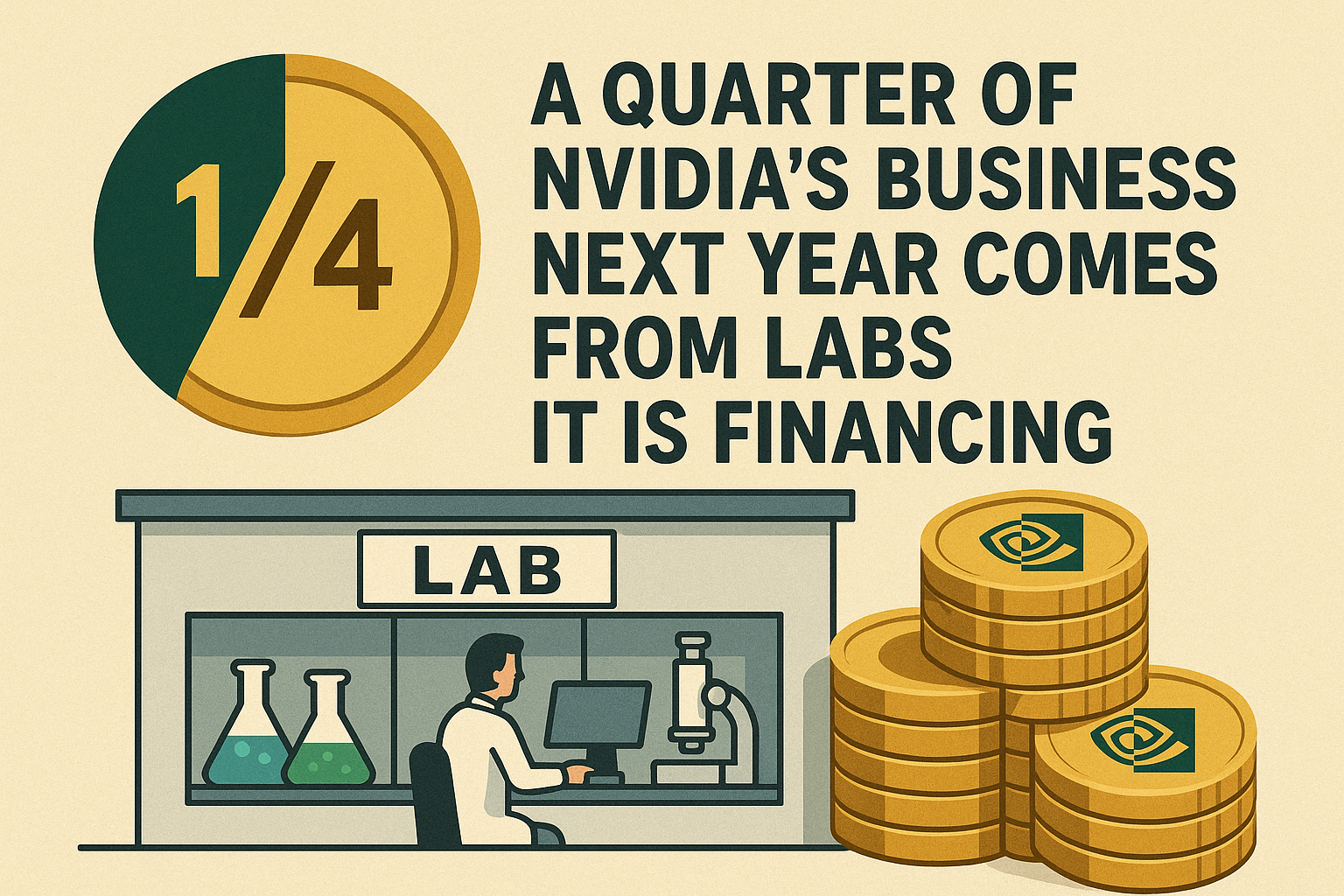
# Nvidia’s AI Boom Raises Questions as Funded Labs Drive a Quarter of Future Business
Nvidia’s dominance in artificial intelligence is entering a new phase—one where the company is not only selling the chips powering the AI revolution, but also helping finance some of the customers buying them.
According to comments from Nvidia chief financial officer Colette Kress on August 26, demand from AI labs that Nvidia has supported through its own balance sheet is expected to contribute roughly a quarter of the company’s business next year. Reports indicate Nvidia has already committed nearly US$50 billion to AI companies and has lined up commitments worth more than US$500 billion.
The development highlights both the scale of Nvidia’s influence in the AI market and the growing debate around “circular financing” in the sector.
## Nvidia’s Role Beyond Chipmaker
Nvidia has become the central supplier of the AI infrastructure boom. Its graphics processing units, or GPUs, are essential for training and running large AI models. Major technology companies, cloud providers, startups, and AI research labs all rely heavily on Nvidia hardware to build competitive AI systems.
But Nvidia’s growing financial involvement in AI labs changes the nature of that relationship. Instead of acting purely as a vendor, Nvidia is increasingly becoming an investor, partner, and enabler of the very companies that drive demand for its chips.
This strategy can help AI labs secure the enormous computing resources they need. It can also help Nvidia lock in long-term demand for its hardware, software, and data center platforms.
## Why This Matters
The AI industry is extremely capital-intensive. Building advanced AI models requires massive clusters of high-performance chips, networking equipment, power, cooling, cloud infrastructure, and engineering talent. For many AI labs, access to Nvidia GPUs is one of the most important factors determining whether they can compete.
By investing in or financing AI labs, Nvidia may be accelerating the growth of the market it serves. This can create a powerful feedback loop:
1. Nvidia provides funding or financial support to AI companies.
2. Those companies use capital to buy Nvidia chips and infrastructure.
3. Nvidia records increased revenue from those purchases.
4. Higher revenue reinforces Nvidia’s market leadership and investor confidence.
Supporters may argue this is simply strategic financing in a fast-growing industry. Nvidia is helping build the ecosystem around its technology, similar to how other major tech firms have invested in developers, cloud partners, or platform companies.
However, critics may see risks in this arrangement.
## The Concern Over “Circular Financing”
The term “circular financing” refers to a situation where a company invests in customers, and those customers then use the money to buy products from that same company. While not necessarily improper, it can raise questions about how much of the demand is organic and how much is supported by supplier-backed funding.
If roughly a quarter of Nvidia’s future business comes from labs it is financing, investors and analysts may want more clarity on the quality and sustainability of that demand.
Key questions include:
– Would these AI labs buy the same amount of Nvidia hardware without Nvidia’s financial support?
– Are these purchases based on real long-term business needs or aggressive growth expectations?
– What happens if AI companies struggle to generate enough revenue from their models?
– Could Nvidia face financial exposure if funded labs fail or reduce spending?
These questions do not mean Nvidia’s business is weak. In fact, demand for AI chips remains enormous. But they do show that the AI economy is becoming more complex, with financing, infrastructure, and product demand increasingly tied together.
## A Sign of AI’s Massive Infrastructure Race
The reported US$500 billion in future commitments reflects the sheer scale of investment now flowing into AI. Companies are racing to build larger models, faster inference systems, and global AI platforms. This race requires unprecedented levels of computing power.
Nvidia is in a unique position because it controls much of the hardware and software stack required for advanced AI. Its GPUs, CUDA software ecosystem, networking solutions, and data center systems have made it the default infrastructure provider for many AI developers.
As a result, Nvidia is not just benefiting from AI growth—it is actively shaping the pace and direction of that growth.
## Opportunity and Risk
For Nvidia, financing AI labs could be a smart strategic move. It strengthens customer relationships, encourages ecosystem expansion, and helps ensure that emerging AI companies build on Nvidia technology rather than competing alternatives.
But the strategy also introduces risk. If AI spending slows, if labs fail to monetize their products, or if investors become skeptical of supplier-financed demand, Nvidia could face pressure. The company’s future growth may depend not only on chip innovation but also on the financial health of the AI companies it supports.
## Conclusion
Nvidia’s involvement in financing AI labs shows how deeply it is embedded in the artificial intelligence boom. The company is no longer just selling the tools of AI—it is helping fund the builders of the industry.
This could strengthen Nvidia’s position as the backbone of global AI infrastructure. At the same time, it raises important questions about the sustainability of AI demand and the financial relationships behind the sector’s rapid expansion.
As AI investment continues to grow, Nvidia’s strategy will be closely watched by investors, competitors, regulators, and the wider technology industry. The company’s success may depend on whether today’s massive AI infrastructure spending turns into lasting economic value—or whether parts of the boom are being supported by a cycle of financing and chip purchases.
Leave a Reply